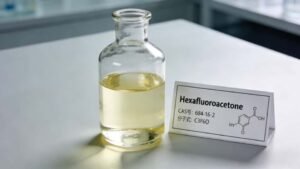
Fluoropolymers are often described in terms of their monomers—tetrafluoroethylene (TFE), vinylidene fluoride (VDF), or hexafluoropropylene (HFP). However, the performance characteristics that differentiate high-end fluoropolymers from standard grades frequently originate not from bulk monomer chemistry alone, but from specialty fluorinated intermediates introduced during modification or comonomer synthesis. Hexafluoroacetone (HFA) is one such strategic intermediate. Underestimating its role can result in overlooking critical structure–property relationships in advanced fluoropolymers. The challenge is not merely producing fluoropolymers—it is engineering materials with enhanced thermal resistance, chemical inertness, dielectric stability, and processability. HFA contributes precisely to these performance parameters.
Hexafluoroacetone plays a crucial role in fluoropolymers by serving as a precursor to fluorinated comonomers, functional modifiers, and CF₃-containing building blocks that enhance thermal stability, chemical resistance, dielectric performance, low surface energy, and processability in high-performance fluoropolymer systems. It enables controlled introduction of trifluoromethyl (CF₃) functionality into polymer backbones or side chains, thereby tuning mechanical, electrical, and chemical properties.
To understand this role in depth, we must analyze structural chemistry, polymer modification pathways, performance enhancement mechanisms, industrial integration, and strategic material engineering considerations.
1. Structural Contribution: CF₃ Functionalization
The fundamental structural feature of hexafluoroacetone is:
(CF₃)₂CO
The dual trifluoromethyl (CF₃) groups introduce:
• Strong electron-withdrawing effects
• Exceptional bond strength (C–F ~485 kJ/mol)
• Low polarizability
• Reduced surface energy
In fluoropolymers, CF₃ substitution modifies:
• Chain flexibility
• Crystallinity
• Thermal transitions
• Dielectric behavior
Structural Comparison of Substituents
| Substituent | Polarity | Steric Effect | Thermal Stability |
|---|---|---|---|
| CH₃ | Moderate | Small | Moderate |
| CF₃ | Strongly electron-withdrawing | Larger | Very high |
CF₃ groups increase bulkiness and reduce intermolecular interactions, which affects polymer morphology.
2. Precursor to Fluorinated Comonomers
HFA is converted into fluorinated intermediates that become comonomers in fluoropolymer systems.
These intermediates are incorporated into:
• Modified FEP (fluorinated ethylene propylene)
• PFA (perfluoroalkoxy) resins
• Specialty copolymers
Why Comonomers Matter
Pure PTFE (polytetrafluoroethylene) is difficult to process due to:
• High melting point
• Lack of melt flow
Incorporating fluorinated comonomers derived from HFA improves:
• Melt processability
• Mechanical toughness
• Flexibility
Comonomer Effect Overview
| Polymer Property | Effect of CF₃ Comonomer |
|---|---|
| Melt flow | Improved |
| Crystallinity | Slightly reduced |
| Flexibility | Increased |
| Thermal resistance | Maintained |
Thus, HFA indirectly enhances processability without sacrificing chemical resistance.
3. Enhancement of Chemical Resistance
Fluoropolymers are used in:
• Chemical processing plants
• Acid-resistant linings
• Semiconductor etching environments
CF₃ groups derived from HFA strengthen resistance by:
• Shielding carbon backbone
• Increasing fluorine density
• Lowering reactivity toward acids and bases
Chemical Resistance Comparison
| Polymer Type | Resistance to Strong Acids |
|---|---|
| Standard polyethylene | Low |
| PTFE | Very high |
| Modified fluoropolymer (CF₃-enhanced) | Exceptional |
HFA-based modifications allow fine-tuning of this performance.
4. Dielectric and Electrical Performance
In electronics and semiconductor industries, dielectric properties are critical.
CF₃-containing polymers exhibit:
• Low dielectric constant
• Low dielectric loss
• High breakdown voltage
Electrical Performance Parameters
| Property | CF₃-Modified Fluoropolymer |
|---|---|
| Dielectric constant | Lower than hydrocarbon polymers |
| Insulation stability | Excellent |
| Thermal stability | High |
HFA-derived components are especially important in:
• Wire insulation
• Semiconductor wafer processing
• High-frequency communication systems
5. Surface Energy Reduction
Fluoropolymers are known for low surface energy.
CF₃ groups further reduce surface energy, improving:
• Anti-fouling performance
• Non-stick behavior
• Chemical inertness
Surface Energy Comparison
| Material | Surface Energy (mN/m) |
|---|---|
| Polyethylene | ~31 |
| PTFE | ~18 |
| CF₃-enhanced fluoropolymer | Potentially lower |
This reduction is critical in:
• Anti-adhesion coatings
• Mold release agents
• Chemical transport tubing
6. Thermal Stability Contribution
Fluoropolymers are valued for high thermal stability.
CF₃ groups:
• Increase resistance to thermal degradation
• Improve oxidative stability
• Enhance performance at >250°C
Thermal Resistance Overview
| Polymer | Continuous Use Temperature |
|---|---|
| PVC | ~60–70°C |
| Polyethylene | ~100°C |
| PTFE | ~260°C |
| Modified fluoropolymer | Comparable or improved |
HFA-derived structures maintain high thermal integrity while adjusting flexibility.
7. Processability Improvements
One limitation of fully fluorinated polymers is limited melt flow.
Introducing HFA-derived components:
• Disrupts crystallinity
• Improves melt processability
• Enables extrusion and molding
This enables:
• Wire coating
• Film production
• Injection molding of fluoropolymer parts
8. Semiconductor Industry Applications
Fluoropolymers derived from HFA intermediates are used in:
• Plasma-resistant components
• Etching chamber linings
• Chemical-resistant piping
Requirements include:
• Zero contamination
• Plasma stability
• Extreme chemical resistance
HFA-based materials help meet these standards.
9. Strategic Position in Fluorochemical Supply Chain
The fluoropolymer supply chain includes:
Fluorspar → Hydrogen fluoride → Fluorinated intermediates → Hexafluoroacetone → Comonomers → Fluoropolymers
HFA serves as a transformation node where highly functionalized CF₃ groups are introduced in a controlled manner.
10. Economic Value Contribution
Although HFA volume is lower than bulk monomers like TFE, its impact on polymer performance significantly increases material value.
Value Perspective
| Factor | Commodity Polymer | HFA-Modified Fluoropolymer |
|---|---|---|
| Base cost | Moderate | Higher |
| Performance | Standard | Enhanced |
| Market segment | General industry | High-tech, aerospace, electronics |
HFA-derived modifications elevate polymer grade into premium categories.
11. Why HFA Is Not Directly Polymerized
Hexafluoroacetone contains a carbonyl group and lacks the double bond necessary for standard radical polymerization.
Instead, it is:
• Chemically transformed into comonomers
• Incorporated via derivative intermediates
• Used in post-polymer modification
This indirect role is more powerful than direct polymerization would be.
12. Material Engineering Perspective
From a materials science standpoint, HFA provides:
• Controlled steric bulk (CF₃ groups)
• Enhanced chain spacing
• Improved flexibility without compromising stability
These structural effects allow fine-tuning of:
• Glass transition temperature (Tg)
• Melt viscosity
• Mechanical strength
Final Technical Conclusion
Hexafluoroacetone plays a vital role in fluoropolymers not as a primary monomer, but as a strategic intermediate used to introduce CF₃ functionality into polymer systems. Through conversion into fluorinated comonomers and modifiers, it enhances melt processability, chemical resistance, thermal stability, dielectric performance, and surface energy characteristics. Its contribution allows fluoropolymers to meet the demanding requirements of semiconductor manufacturing, aerospace engineering, chemical processing, and advanced electronics. HFA occupies a central structural position in the fluoropolymer value chain, enabling high-performance materials that go beyond the capabilities of standard fluoropolymers.
Need High-Purity Hexafluoroacetone for Fluoropolymer Applications?
At Sparrow-Chemical, we supply high-purity hexafluoroacetone suitable for fluoropolymer modification, specialty comonomer synthesis, and advanced fluorinated material production. Our materials are manufactured under strict moisture-controlled systems and supported by comprehensive technical documentation.
Visit:
https://sparrow-chemical.com/
If your fluoropolymer project requires reliable CF₃-functional intermediates, our technical team is ready to support your material development and sourcing strategy.