When engineers, buyers, and plant designers compare fluoropolymers, the mistake is usually not choosing a “bad” material, but choosing the wrong fluoropolymer for the wrong failure mode. A lining that survives acid may still crack under flexing. A resin that processes beautifully may not tolerate the highest service temperature. A polymer that is ideal for semiconductor purity may be unnecessarily expensive for a chemical storage tank. That is why confusion around PTFE, PVDF, and the broader fluoropolymer family leads to costly overdesign, underperformance, avoidable shutdowns, and shorter equipment life. The good news is that these materials are not mysterious once you compare them through the right lens: molecular structure, fluorine content, processability, thermal window, chemical resistance, mechanical behavior, permeability, purity, and total installed cost.
PTFE, PVDF, and other fluoropolymers differ mainly in fluorine content, molecular structure, melt-processability, mechanical strength, temperature capability, and fabrication method. PTFE is usually the benchmark for chemical inertness, low friction, and high-temperature service, but it is not melt-processable like ordinary thermoplastics. PVDF is easier to process, mechanically tougher in many structural applications, and widely used in piping, membranes, lithium battery binders, and architectural coatings. Other fluoropolymers such as PFA, FEP, ETFE, and ECTFE fill the performance gaps between PTFE and PVDF by balancing purity, transparency, weldability, toughness, permeation resistance, and cost. The right choice depends less on brand names and more on the actual duty conditions, fabrication route, and failure risks of the application. (化学公司)
If you are selecting a fluoropolymer for chemical processing, semiconductor systems, wire and cable, filtration, coatings, or fluid handling, the most useful question is not “Which one is best?” but “Best for what combination of chemistry, temperature, stress, fabrication, purity, and budget?” That is the perspective this guide will use, so you can move from broad material names to a practical engineering decision.
Start with the family: what fluoropolymers actually are
Fluoropolymers are a class of high-performance polymers whose properties are largely driven by carbon–fluorine bonds, among the strongest single bonds in organic chemistry. That bond strength is the reason fluoropolymers are widely associated with chemical resistance, weatherability, electrical performance, flame resistance, and long-term durability. But “fluoropolymer” is not a single material category in practice. It includes fully fluorinated materials such as PTFE and nearly fully fluorinated copolymers such as PFA and FEP, as well as partially fluorinated materials such as PVDF, ETFE, and ECTFE, each with very different processing and end-use behavior. PTFE is the archetypal fluoropolymer and remains the reference point for inertness and non-stick performance. PVDF, by contrast, is often preferred when designers need a better balance of chemical resistance, mechanical properties, and conventional melt processing. ETFE and ECTFE are often chosen when toughness, film performance, permeation resistance, or easier fabrication matter more than absolute inertness. PFA and FEP sit closer to PTFE in surface chemistry and purity, but unlike PTFE they are melt-processable. (科学直达)
A useful way to understand the family is to stop thinking in brand shorthand and start thinking in engineering trade-offs. In general, as fluorine content rises, surface energy falls, chemical inertness improves, and friction tends to decrease. But higher fluorination can also make certain materials harder to process, more expensive, or less structurally useful in load-bearing fabricated parts. PTFE illustrates that perfectly: it offers extraordinary inertness and service temperature, yet it is not melt-processable in the same sense as PVDF, ETFE, ECTFE, PFA, or FEP. PVDF illustrates the other side: it does not equal PTFE in universal inertness, but it is far easier to process on standard equipment and often delivers a more practical balance in industrial fabrication. That is why material selection rarely follows a simple “more fluorine is better” rule. It follows a system-level rule: “best match to the application.” (化学公司)
The core difference: PTFE versus PVDF in one engineering sentence
If one sentence had to capture the difference, it would be this: PTFE is usually chosen when the application prioritizes maximum chemical inertness, very low friction, and high-temperature stability, while PVDF is usually chosen when the application needs a stronger balance of chemical resistance, structural performance, lower permeability than many commodity plastics, and easier melt processing and fabrication. That is why PTFE dominates in seals, gaskets, high-purity fluid paths, non-stick surfaces, and demanding chemical contact environments, whereas PVDF is heavily used in piping systems, valves, pumps, filtration, membranes, cable insulation, coatings, process equipment, and energy-related applications. Arkema explicitly positions PVDF as having one of the best balances of mechanical properties and melt-processability among fluoropolymers, while Chemours materials literature positions PTFE as a benchmark for low friction, electrical performance, and inertness. (阿科玛高性能聚合物)
That sentence, however, still hides several important technical distinctions. PTFE is a fully fluorinated polymer built from tetrafluoroethylene units. It has a very high melting point and is typically processed by paste extrusion, compression molding, ram extrusion, or sintering routes rather than standard melt extrusion and injection molding in the everyday thermoplastic sense. PVDF is a partially fluorinated thermoplastic built from vinylidene fluoride units, and it can be processed using more conventional polymer equipment similar to that used for PVC or polypropylene. This difference alone changes everything downstream: plant equipment, part geometry, weldability, cycle times, installation method, repair strategy, and cost. A buyer comparing only chemical resistance charts can miss the much bigger commercial reality that processing route and fabrication method often drive total project feasibility. (化学公司)
Comparison table: PTFE, PVDF, and the major fluoropolymer alternatives
| Material | Full name | Fluorination style | Melt-processable? | Relative chemical inertness | Relative mechanical toughness | Typical high-value uses | Practical identity |
|---|---|---|---|---|---|---|---|
| PTFE | Polytetrafluoroethylene | Fully fluorinated | No, not by conventional melt processing | Excellent, benchmark class | Moderate; can creep under load | Seals, gaskets, bearings, liners, high-purity components | The inertness and low-friction reference |
| PFA | Perfluoroalkoxy | Perfluorinated copolymer | Yes | Near-PTFE class | Good | Semiconductor tubing, high-purity fittings, chemical handling, films | PTFE-like chemistry with melt fabrication |
| FEP | Fluorinated ethylene propylene | Perfluorinated copolymer | Yes | Very high | Good | Wire insulation, tubing, films, transparent components | Easier-processing PTFE-family material |
| PVDF | Polyvinylidene fluoride | Partially fluorinated | Yes | High, but below PTFE/PFA in universality | Strong balance | Piping, valves, membranes, lithium battery binders, architectural coatings | Structural, fabricable, industrial workhorse |
| ETFE | Ethylene tetrafluoroethylene | Partially fluorinated copolymer | Yes | Very high | Very high toughness | Films, cable, tubing, architectural cushions, chemical equipment | Tough, moldable, high-performance fluoroplastic |
| ECTFE | Ethylene chlorotrifluoroethylene | Partially fluorinated copolymer | Yes | Very high | Very good | Corrosion-resistant linings, coatings, pipes, semiconductor/PV applications | Strong permeation and corrosion performer |
| PCTFE | Polychlorotrifluoroethylene | Highly fluorinated with chlorine | Yes | High | Rigid, low permeability | Cryogenic seals, barrier applications, specialty components | Barrier-focused specialty fluoropolymer |
| PVF | Polyvinyl fluoride | Partially fluorinated | Yes | Good | Good | Films and weatherable laminates | Surface film specialist |
This comparison is directional rather than absolute, because exact performance depends on grade, filler package, crystallinity, processing history, and service environment. Still, the pattern is consistent across authoritative manufacturer literature: PTFE remains the classic choice for inertness and non-stick behavior; PFA and FEP preserve much of that fluorochemical profile while adding melt-processability; PVDF wins where fabrication convenience and structural utility matter; ETFE and ECTFE offer robust mechanical and fabrication advantages in specific engineered systems. (化学公司)
Why PTFE behaves so differently
PTFE’s reputation comes from its molecular architecture. Because the polymer backbone is heavily shielded by fluorine atoms, many aggressive chemicals have difficulty attacking it under ordinary industrial conditions. This also contributes to its very low surface energy and low coefficient of friction, which is why PTFE is famous in sliding, release, anti-stick, and sealing applications. At the same time, that same structure helps explain why PTFE is not a conventional melt-processable thermoplastic. Its melt viscosity is extraordinarily high, so processors generally shape it through powder metallurgy-like routes such as preforming and sintering or through specialized paste extrusion systems. Chemours product literature explicitly describes PTFE processing around preforming, sintering, granular molding powders, and fine powder routes rather than ordinary “just extrude and mold it like PP” logic. (化学公司)
This has real engineering consequences. PTFE is often outstanding in chemical contact, but it is also known for creep and cold flow under sustained load, especially in unfilled grades. That is why filled PTFE exists: glass-filled, carbon-filled, graphite-filled, bronze-filled, and other modified grades are used when designers need better wear resistance, dimensional stability, or reduced deformation. PTFE also tends to be opaque, relatively soft compared with some structural thermoplastics, and less convenient when the design requires high-throughput molding of complex parts. So while PTFE is frequently the best chemical answer, it is not always the best manufacturing answer. In procurement terms, PTFE is often a “performance-first” material, not automatically the “total installed cost” material. (化学公司)
Why PVDF is often the practical industrial choice
PVDF occupies a very important middle ground. It does not try to beat PTFE at everything. Instead, it wins a remarkable number of real industrial decisions because it combines high chemical resistance with easier processing, easier welding and fabrication, strong mechanical performance, weatherability, abrasion resistance, flame performance, and purity options. Arkema’s Kynar literature emphasizes exactly this profile, including chemical resistance, UV stability, electrochemical stability, fire performance, abrasion resistance, and easy processing on standard equipment. For many piping systems, storage and transfer of corrosive liquids, filtration hardware, membrane applications, cable jacketing, and outdoor building products, that bundle of properties is more commercially useful than maximum inertness alone. (阿科玛高性能聚合物)
PVDF is especially valuable where fabricated thermoplastic construction matters. A plant operator can weld PVDF sheet and pipe into tanks, ducts, scrubbers, and piping systems more easily than working with PTFE. That is a major reason PVDF appears across chemical process industries. It is also a key reason PVDF is prominent in membranes and in lithium-ion battery binder applications, where processability, electrochemical stability, and compatibility with manufacturing routes matter enormously. In architecture, PVDF-based coatings are known for weatherability and color retention. In fluid handling, PVDF often represents the point where performance and manufacturability meet. That is why engineers who know both PTFE and PVDF rarely treat them as interchangeable. They solve different industrial problems even when both belong to the same chemical family. (阿科玛高性能聚合物)
Where PFA and FEP fit between PTFE and PVDF
PFA and FEP are critical because they bridge a key gap: they provide much of the fluorochemical surface behavior associated with PTFE, but unlike PTFE they are melt-processable. That makes them especially valuable in tubing, films, wire insulation, molded fittings, and high-purity fluid handling systems. PFA is often regarded as the premium PTFE-like melt-processable fluoropolymer because it maintains a high temperature capability while allowing extrusion, molding, welding, and fabrication routes that are more difficult with PTFE. FEP also offers excellent electrical properties and processability, and it is widely used in wire and cable as well as transparent tubing and films. Scientific and manufacturer references consistently place PFA closer to PTFE in upper service temperature, with FEP somewhat lower but still highly useful where optical clarity, processing speed, or cost are relevant. (化学公司)
In semiconductor, pharmaceutical, and ultra-pure fluid applications, that distinction becomes decisive. PTFE may offer superb inertness, but PFA is often chosen for tubing, molded manifolds, fittings, and fluid paths because it can be fabricated into precise, weldable, high-purity system components. FEP may be favored where transparency or wire coating behavior is beneficial. This is why a buyer who reduces the comparison to “PTFE versus PVDF” can still miss the best answer. In a high-purity chemical delivery system, the real decision may be “PFA versus PTFE,” not “PVDF versus PTFE.” In a corrosion-resistant fabrication project, the real decision may be “PVDF versus ECTFE.” Material selection works best when the comparison set reflects the actual application category. (化学公司)
ETFE and ECTFE: the tough, fabricable alternatives
ETFE and ECTFE are often underrated because PTFE and PVDF dominate popular discussion, but both materials solve important industrial problems. AGC describes ETFE as a tough fluoropolymer with chemical resistance and electrical properties comparable to more traditional fluoropolymers, while also highlighting improved mechanical strength and moldability relative to some alternatives. That profile explains ETFE’s success in films, cable, tubing, chemical process components, and especially architectural membranes and cushions. It has a reputation for toughness and fabricability that makes it attractive when the component must withstand more abuse than classic inert-liner service. (AGC Chemicals)
ECTFE, meanwhile, is especially interesting where permeation resistance, corrosion resistance, flame performance, and coating/lining behavior are central. Syensqo positions Halar ECTFE around anti-corrosion, wire and cable, semiconductor, and photovoltaic uses, emphasizing chemical resistance, purity, low permeability, fire resistance, and processability. In practice, ECTFE often enters the conversation when the designer wants a robust coating or liner system, good barrier performance, or a melt-processable corrosion-engineering material that sits differently from both PVDF and PTFE. In severe chemical service, ECTFE can be a powerful answer where both mechanical integrity and barrier performance matter, especially in coated ducts, pipe, tank linings, and specialty corrosion-control systems. (Syensqo)
Engineering chart: how the materials differ by decision factor
| Decision factor | PTFE | PFA | FEP | PVDF | ETFE | ECTFE |
|---|---|---|---|---|---|---|
| Maximum chemical inertness | Excellent | Excellent to near-PTFE | Very high | High | Very high | Very high |
| Conventional melt processing | Limited / no | Yes | Yes | Yes | Yes | Yes |
| High-purity fluid systems | High, but fabrication-limited | Excellent | Excellent | Good to very good | Good | Good |
| Low friction / release | Excellent | Excellent | Excellent | Moderate | Moderate | Moderate |
| Mechanical toughness | Moderate | Good | Good | Good to very good | Very good | Very good |
| Structural fabrication / welding | Limited relative to melt-processables | Good | Good | Excellent | Good | Good |
| Outdoor weatherability / UV | Excellent | Excellent | Excellent | Excellent | Excellent | Excellent |
| Permeation/barrier emphasis | Good | Good | Good | Good | Good | Often excellent |
| Transparent film/tubing options | Limited | Yes | Yes | Some grades/forms | Yes | Some forms |
| Typical cost level | High | Higher | High | Moderate to high | High | High |
This chart should not replace a chemical compatibility review or grade-specific data sheet, but it does reflect the broad logic visible across manufacturer and technical references. PTFE wins the inertness and low-friction story. PFA wins when PTFE-like chemistry must be fabricated into premium melt-processable parts. FEP wins where electrical performance, clarity, and processability are needed. PVDF wins the “industrial workhorse” category. ETFE wins on toughness and moldability. ECTFE wins more often than people realize when corrosion plus permeation plus processing define the job. (化学公司)
The most important practical differences buyers should understand
Chemical resistance is not identical across the family
All major fluoropolymers are known for strong chemical resistance, but the resistance profile is not uniform. PTFE is often the benchmark because of its exceptional inertness. PFA and FEP are very close in many chemical environments. PVDF is highly resistant to many acids, halogens, hydrocarbons, alcohols, salts, and oxidants, but it is not chemically universal. Arkema specifically notes broad resistance and gives pH guidance that varies by homopolymer and copolymer grade. This means a project team should never assume “fluoropolymer” automatically means “equally resistant to everything.” Concentration, temperature, pressure, oxidizing strength, abrasion, and stress all matter. (阿科玛高性能聚合物)
Service temperature changes the ranking
PTFE and PFA generally sit at the high end of continuous temperature performance among common fluoroplastics, with FEP lower than PFA and PTFE, and PVDF generally lower again in continuous service rating even though it remains highly capable in many industrial environments. ETFE and ECTFE occupy their own useful ranges and can be excellent within them. A buyer who chooses only from room-temperature chemical charts can make a wrong decision at elevated temperature, where permeation, softening, creep, and long-term property retention become much more significant. (科学直达)
If you need to injection mold, weld, extrude long pipe, produce clear film, or fabricate complex thermoplastic equipment, then PTFE may be the wrong fit even if its chemistry is attractive. In those cases, PFA, FEP, PVDF, ETFE, or ECTFE may be more realistic. Conversely, if the need is a chemically inert gasket, bearing surface, valve seat, or non-stick interface, PTFE may be far more logical than a more easily processed thermoplastic. This is why experienced fluoropolymer selection starts with the component manufacturing route and installation method, not just the fluid chemistry. (化学公司)
Purity and contamination risk matter in semiconductor and pharma systems
For ultra-pure fluid delivery, trace contamination, extractables, weldability, tubing form, fitting geometry, and cleaning protocols may matter more than general chemical resistance alone. That is one reason PFA is so prominent in semiconductor chemical delivery systems. PTFE remains important, but melt-processable high-purity fluoropolymers often dominate where system architecture requires precise tubing, molded components, and clean fabrication. (化学公司)
Mechanical behavior matters more than many people expect
A lining or seal does not fail only by chemical attack. It also fails by creep, stress cracking, abrasion, permeation, impact, thermal cycling, and fabrication defects. PVDF, ETFE, and ECTFE are frequently selected because their balance of toughness, rigidity, and processability is simply more appropriate for the geometry and loading conditions involved. PTFE is chemically outstanding, but in some structural or fabricated systems it is not the easiest material to make behave dimensionally. (阿科玛)
Application-by-application selection logic
Chemical processing equipment
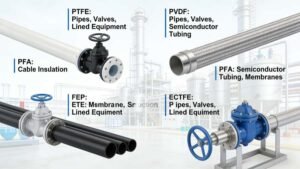
For highly aggressive chemicals, PTFE, PFA, and certain ECTFE/PVDF systems all deserve consideration, but they do not play the same role. PTFE is common in gaskets, seals, valve seats, packings, and liners where surface inertness dominates. PVDF is widely used in fabricated tanks, pipe, valves, pumps, and filtration components where welding and thermoplastic fabrication are needed. ECTFE enters where anti-corrosion coatings, barrier properties, and fabricated corrosion-control systems are central. PFA becomes attractive in premium high-purity or high-temperature fluid handling. The real question is not which polymer resists corrosion, because several do, but which one can be fabricated, installed, inspected, and maintained most effectively in the specific equipment architecture. (阿科玛)
Semiconductor and high-purity fluid handling
PFA and high-purity PTFE are major players because cleanliness, chemical purity, and system compatibility are decisive. FEP is also important in certain tubing and insulation roles. PVDF can still appear in broader industrial fluid systems, but when the purity threshold becomes extreme, perfluorinated melt-processables often move to the front of the selection list. (化学公司)
Wire and cable
FEP, PFA, ETFE, PVDF, and ECTFE all have important roles depending on flame performance, flexibility, temperature, abrasion, and installation environment. FEP and PFA are known for electrical performance and processing into coatings; ETFE is favored where toughness is crucial; ECTFE is valued in specialty cable environments because of chemical and flame performance; PVDF appears in demanding cable jackets where abrasion and fire properties matter. (化学公司)
Films, membranes, and architectural systems
ETFE is a standout in architectural films and cushions because of toughness, weatherability, and light transmission. PVDF plays a major role in membranes and durable coatings. PTFE-coated fabrics belong to another architectural and filtration story altogether. This is a good example of why “fluoropolymer” is too broad a buying category: film architecture, membrane filtration, and anti-stick sealing are all fluoropolymer markets, but they are not solved by the same resin. (AGC Chemicals)
Energy and electrochemical systems
PVDF is especially prominent in lithium-ion battery systems because of electrochemical stability and processability in binder applications. PTFE also appears in specialty separator and sealing contexts, but the mainstream electrochemical manufacturing value chain has made PVDF one of the most commercially important fluoropolymers outside traditional chemical equipment. This is another reason PVDF remains strategically important even though PTFE often gets more public recognition. (阿科玛高性能聚合物)
A practical selection framework for real projects
When selecting among PTFE, PVDF, PFA, FEP, ETFE, and ECTFE, a useful workflow is to rank the application against seven questions. First, what is the actual chemical environment, including upset conditions, cleaning cycles, and contamination risks? Second, what is the maximum continuous and intermittent temperature? Third, is the component a seal, a liner, a molded part, a welded fabrication, a film, a membrane, or cable insulation? Fourth, what mechanical loads will it experience: compression, flex, abrasion, vacuum, permeation, or impact? Fifth, is purity critical? Sixth, what manufacturing route is realistic at volume? Seventh, what is the cost of failure versus the cost of over-specification? When those seven questions are answered, the shortlist usually becomes obvious. The most common mistake is skipping straight from “acid service” to “use PTFE” without evaluating fabrication method or lifecycle economics. (化学公司)
In many projects, the result is not one fluoropolymer but a system combination. For example, a chemical skid may use PTFE seats and gaskets, PVDF piping, PFA tubing in high-purity branches, and ECTFE-coated components where permeation and corrosion justify it. Advanced engineering rarely treats fluoropolymers as a single-choice competition. It treats them as a toolkit.
Common misconceptions that lead to expensive mistakes
One common misconception is that PTFE is automatically the best fluoropolymer. It is often the most inert, but “best” depends on whether the component must also be welded, molded, load-bearing, transparent, or economical to fabricate. Another misconception is that PVDF is just a cheaper substitute. In reality, PVDF is often selected because it is the superior engineering choice for fabricated systems, not because it is merely more affordable. A third misconception is that all fluoropolymers have the same purity, permeation, and processability profile. They do not. A fourth misconception is that if a chemical compatibility chart says “resistant,” the job is done. In reality, stress, temperature, pressure, permeation, cleaning agents, and installation defects determine service life just as much as the chemical itself. (阿科玛高性能聚合物)
The simplest buying rule
If your top priority is maximum inertness, low friction, and high-temperature sealing or lining, start with PTFE. If your top priority is fabricated industrial equipment, weldable piping, membranes, or a strong all-around balance, start with PVDF. If you need PTFE-like chemistry plus high-purity melt-processability, start with PFA. If you need clear, processable fluoropolymer tubing or wire insulation, look hard at FEP. If you need high toughness and film or cable performance, evaluate ETFE. If you need corrosion-control coatings, good processability, and strong permeation resistance, add ECTFE to the shortlist. That single screening rule will eliminate a large share of wrong first choices. (化学公司)
Final takeaway
The difference between PTFE, PVDF, and other fluoropolymers is not just a chemistry lesson. It is an engineering selection problem shaped by structure, fluorination level, fabrication route, purity needs, temperature, load, and lifecycle risk. PTFE remains the iconic fluoropolymer because it sets the standard for inertness and low-friction performance. PVDF remains indispensable because it is often the most practical fabricated fluoropolymer in real industrial systems. PFA, FEP, ETFE, and ECTFE are not secondary materials; they are the reason modern engineers can fine-tune purity, toughness, transparency, weldability, permeability, and corrosion performance instead of forcing one resin to do every job. The smartest selection is rarely the most famous resin. It is the one whose strengths align most precisely with your process, component geometry, fabrication route, and failure consequences. (化学公司)
Let’s match the right fluoropolymer to your application
If you are comparing PTFE, PVDF, PFA, FEP, ETFE, ECTFE, or other fluoropolymer options for chemical processing, wire and cable, coatings, membranes, high-purity systems, or corrosion-resistant equipment, contact Sparrow-Chemical for application-focused support and product sourcing guidance: https://sparrow-chemical.com/