Many people hear that fluorine is “everywhere,” but that statement is too vague to be useful. Buyers, engineers, students, and procurement teams often know fluorine is important, yet they cannot clearly explain which products actually use it, why those products need it, or what form of fluorine is involved. That confusion creates practical problems: people mix up fluoride in toothpaste with fluoropolymers in seals, fluorinated drugs with refrigerants, and semiconductor process gases with PFAS-related surface treatments. The result is poor product understanding, weak sourcing decisions, and an incomplete picture of how deeply fluorine chemistry is embedded in modern manufacturing. The most useful way to solve this is to look directly at the product categories that use fluorine, the performance fluorine delivers in each category, and the commercial logic behind why manufacturers keep using it.
Products that use fluorine include toothpaste and dental treatments, nonstick cookware, wire and cable insulation, chemical-resistant seals and linings, refrigerants and cooling fluids, pharmaceutical products, crop-protection chemicals, semiconductor etching and chamber-cleaning gases, lithium-ion battery materials, waterproof and oil-repellent surface treatments, specialty coatings, and many high-performance industrial plastics. Fluorine is used because it can improve chemical resistance, thermal stability, electrical performance, surface repellency, biological activity, and process precision in ways many other elements cannot.
To answer the question properly, it is not enough to list a few consumer examples. Fluorine appears in very different chemical forms, and those forms behave very differently in products. In one product, fluorine is present as fluoride ion to help protect teeth. In another, it is part of a fluoropolymer that resists corrosion and sticking. In another, it is built into a drug molecule to improve potency or metabolic stability. In another, it is part of a gas used to etch nanoscale features on semiconductor wafers. Once you see those differences clearly, the product landscape becomes much easier to understand.
Why So Many Products Use Fluorine
The reason fluorine appears in so many products is fundamentally chemical. Fluorine is the most electronegative element, and the carbon–fluorine bond is one of the strongest single bonds in organic chemistry. That bond strength can make materials more resistant to heat, solvents, UV exposure, oxidation, and chemical attack. In other systems, fluorine changes how a molecule behaves biologically, how it wets a surface, or how it reacts under plasma conditions. This is why fluorine can support products as different as PTFE-lined pumps, cavity-prevention toothpaste, modern drug molecules, and high-purity semiconductor chamber-cleaning gases. Reviews of fluorinated drugs note that fluorine is widely used to tune metabolic stability, lipophilicity, and target interactions, while EPA materials on fluoropolymers emphasize their value in sectors such as aerospace, automotive, building and construction, chemical processing, electronics, semiconductors, and textiles.
A second reason fluorine-based products are so common is that fluorine chemistry works across both consumer and industrial value chains. Some fluorinated products are visible to ordinary consumers, such as toothpaste, stain-resistant textiles, fluorinated ski wax history, or nonstick cookware. But a much larger share of fluorine use sits upstream inside industrial infrastructure: cable insulation, gaskets, O-rings, membranes, battery binders, etching gases, refrigerants, coatings, and specialty intermediates used to manufacture drugs and crop-protection products. In other words, fluorine often matters most in the parts of the economy the end user never sees directly.
A Quick Map of Product Types That Use Fluorine
| Product category | Typical fluorine chemistry | Why fluorine is used | Familiar examples |
|---|---|---|---|
| Oral-care products | Sodium fluoride, stannous fluoride, sodium monofluorophosphate | Helps prevent cavities and supports enamel remineralization | Toothpaste, mouth rinses, dental varnishes |
| Nonstick and chemical-resistant products | PTFE, PFA, FEP, PVDF, ETFE | Low surface energy, nonstick behavior, chemical resistance, heat resistance | Cookware coatings, seals, hoses, tubing, liners |
| Pharmaceutical products | Fluorinated small molecules and intermediates | Improves potency, stability, selectivity, and pharmacokinetics | Tablets, injectables, imaging agents, antivirals |
| Crop-protection products | Fluorinated agrochemical actives and intermediates | Enhances field performance and molecular stability | Herbicides, fungicides, insecticides |
| Refrigeration and cooling products | HFCs, HFOs, fluorinated heat-transfer fluids | Useful thermodynamics and heat-transfer performance | AC systems, chillers, refrigeration equipment |
| Electronics manufacturing products | NF3, CF4, C2F6, fluoropolymers | Plasma etching, chamber cleaning, chemical compatibility | Semiconductor fabs, display lines, solar manufacturing |
| Battery products | PVDF, LiPF6, fluorinated additives | Electrochemical stability, adhesion, interphase control | Lithium-ion cells, EV batteries, energy storage systems |
| Water/oil-repellent surface products | Fluorinated coatings and finishes | Low surface energy, repellency, anti-fouling | Specialty textiles, glass treatments, industrial coatings |
This table is the shortest possible answer, but each category deserves a closer look because the commercial and technical logic is different in each case.
Dental and Oral-Care Products
The most familiar products that use fluorine are dental products. In these applications, fluorine normally appears as fluoride ion in compounds such as sodium fluoride, stannous fluoride, or sodium monofluorophosphate. The purpose is not decorative and not simply “chemical protection” in an abstract sense. Fluoride is used because it helps prevent tooth decay and supports enamel remineralization. The CDC states that fluoride toothpaste and fluoridated water help protect against cavities, and its fluoridation materials present community water fluoridation as an effective and cost-efficient public-health measure for reducing tooth decay.
In product terms, this means fluorine is present in ordinary toothpaste, children’s toothpaste, professional dental gels, mouth rinses, varnishes, and in some regions treated drinking water systems. Although this use is widely recognized, it is chemically very different from fluorinated plastics or fluorinated gases. Here the active value comes from controlled delivery of fluoride ion, not from a stable carbon–fluorine polymer backbone. That distinction matters. A procurement manager sourcing fluoride salts for oral-care formulation is dealing with efficacy, concentration, taste, abrasive compatibility, stability, and regulatory labeling. A buyer sourcing PTFE tubing or PVDF binder is dealing with an entirely different technical framework.
There is also a useful commercial lesson here: fluorine can add value at very low dosage. A toothpaste does not need to be “highly fluorinated” in the way a fluoropolymer is. It only needs the right fluoride chemistry at the right concentration in a stable formulation. This shows that fluorine’s value is not always about volume. In many product categories, it is about highly leveraged functionality.
Common Oral-Care Products That Use Fluorine
| Product | Fluorine-containing ingredient | Primary purpose |
|---|---|---|
| Daily toothpaste | Sodium fluoride or sodium monofluorophosphate | Cavity prevention |
| Sensitivity toothpaste | Often stannous fluoride | Cavity prevention plus sensitivity/gum-care support |
| Mouth rinse | Sodium fluoride | Supplemental fluoride exposure |
| Dental varnish/gel | Professional fluoride formulations | Targeted remineralization support |
| Fluoridated water supply | Fluoride at controlled concentration | Population-level cavity prevention |
Nonstick Cookware, Seals, Tubing, Linings, and High-Performance Plastics
A second major product family that uses fluorine is fluoropolymers. These are high-performance plastics in which fluorine is built into the polymer structure. The best-known consumer example is nonstick cookware coated with PTFE. The surface works because fluorine-rich polymer chemistry creates low surface energy, which helps food release more easily and makes the surface easier to clean. But from an industrial standpoint, cookware is only a small visible corner of a much larger product universe.
EPA materials note that fluoropolymers impart valuable properties such as fire resistance and oil, stain, grease, and water repellency and are used across aerospace, automotive, construction, chemical processing, electronics, semiconductors, and textiles. In practical product terms, that means fluorine is found in chemical-resistant gaskets, valve seats, pump components, fluoropolymer-lined pipes, hose interiors, filtration membranes, wire and cable insulation, release films, architectural membranes, corrosion-resistant coatings, and countless sealing and lining products used where conventional plastics or elastomers fail.
The reason these products use fluorine is straightforward: fluoropolymers can withstand aggressive chemicals, elevated temperatures, weathering, and demanding electrical environments. PTFE is famous for low friction and inertness. PFA and FEP are chosen for high-purity tubing and melt-processable fluoropolymer applications. PVDF combines fluorine-driven chemical resistance with better structural processability than PTFE in many applications, which is why it shows up in pipes, membranes, coatings, and battery systems. ETFE and ECTFE are used where toughness, weatherability, and process performance matter.
For industrial buyers, this category is one of the most important answers to the question “what products use fluorine?” because fluoropolymer-based products often sit in critical service. They are not “nice-to-have” materials. They are selected when leaks, contamination, swelling, corrosion, or dielectric failure would be expensive or dangerous. This is why fluorine is so common in high-specification industrial hardware.
Common Fluoropolymer-Based Products
| Product type | Typical fluoropolymer | Why fluorine is valuable |
|---|---|---|
| Nonstick cookware coating | PTFE | Low surface energy and release properties |
| Chemical hose/tubing liner | PTFE, FEP, PFA | Solvent and acid resistance |
| O-rings, seals, gaskets | Fluoropolymers / fluorinated elastomer systems | Chemical compatibility and heat resistance |
| High-purity tubing | PFA, FEP | Clean fluid handling and inertness |
| Architectural films | ETFE | Weatherability and durability |
| Cable insulation | FEP, ETFE, PVDF | Heat resistance and dielectric performance |
| Chemical tank lining/coating | ECTFE, PVDF | Long service life in corrosive duty |
Pharmaceutical Products
Many pharmaceutical products use fluorine because fluorine can improve how drug molecules behave. Scientific reviews on fluorinated drugs describe fluorine as an important tool in medicinal chemistry because it can enhance metabolic stability, lipophilicity, target binding, and overall biological performance. One 2024 review highlighted that 12 of the 55 drugs approved by the FDA in 2023 were fluorinated, underscoring how common fluorine has become in modern small-molecule drug design.
In product terms, this means fluorine appears in finished tablets, capsules, injectables, diagnostic agents, oncology drugs, antiviral products, CNS drugs, cardiovascular products, and many specialty therapies. Sometimes the fluorine is a single fluorine atom added to an aromatic ring. Sometimes it is a trifluoromethyl group or another fluorinated motif built into the active pharmaceutical ingredient. The point is not that consumers see “fluorine” on the label. The point is that the final drug product may depend on fluorinated chemistry to meet efficacy, stability, or dosing requirements.
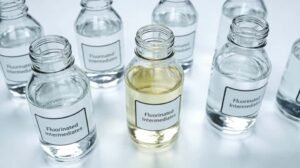
This category is especially important for chemical suppliers because the visible finished product is only the end of a long value chain. Upstream of the tablet or injection are fluorinated intermediates, building blocks, custom-synthesis steps, and tightly controlled impurity specifications. A pharmaceutical company may only use a small mass of fluorinated intermediate in a synthesis route, but that intermediate can be strategically critical. This is why fluorinated fine chemicals and custom synthesis services remain so important commercially.
From a product-positioning standpoint, fluorine in pharmaceuticals is very different from fluorine in plastics. In polymers, fluorine often creates stability and inertness. In pharmaceuticals, fluorine often creates precise changes in molecular behavior. That dual role is a big part of why fluorine chemistry is so commercially powerful.
Types of Pharmaceutical Products That Commonly Use Fluorine
| Product type | How fluorine contributes |
|---|---|
| Oral tablets/capsules | Can improve potency, absorption, or metabolic stability |
| Injectable drugs | May support target selectivity and activity |
| Diagnostic imaging agents | Fluorinated structures may contribute to imaging performance or pharmacology |
| Antiviral/oncology/CNS drugs | Fluorine often used in medicinal chemistry optimization |
| Proprietary API intermediates | Enables synthesis of fluorinated final actives |
Crop-Protection Products
A large number of crop-protection products also use fluorine. This includes herbicides, fungicides, and insecticides that contain fluorinated active ingredients or rely on fluorinated intermediates during synthesis. Although this category receives less public attention than pharmaceuticals, it uses similar medicinal-chemistry logic: fluorine can alter stability, selectivity, field persistence, lipophilicity, and bioactivity.
The finished products here are not just “chemicals” in the abstract. They are commercial crop formulations sold into agriculture, horticulture, seed treatment, and pest management channels. Behind those products are fluorinated aromatic building blocks, trifluoromethyl-containing intermediates, and other specialty fluorinated molecules. In many cases, fluorine is used because it allows the active ingredient to perform better under real field conditions while maintaining an acceptable application profile.
For procurement professionals, the key insight is that many finished agrochemical products contain fluorine even if the buyer never thinks of them as “fluorine products.” The fluorine may be hidden inside the active molecule rather than visible as a listed functional ingredient category. This is one reason fluorine chemistry remains central to fine chemical manufacturing and export-oriented synthesis supply chains. Reviews of fluorinated medicinal chemistry also note the broader role of fluorine in biological-performance design, which extends conceptually into agrochemical development.
Refrigerators, Air Conditioners, Chillers, and Cooling Systems
Many cooling products use fluorine because a large share of refrigerants and specialty thermal-management fluids are fluorinated molecules. This includes numerous air-conditioning systems, commercial refrigeration units, automotive cooling circuits, industrial chillers, heat pumps, and certain specialty electronics-cooling systems. The specific refrigerant family varies by era and regulation, but fluorine remains central because fluorinated molecules can deliver useful pressure-temperature characteristics, heat-transfer performance, and system compatibility.
The product-level consequence is simple: if you look at a modern HVAC system, supermarket refrigeration unit, or industrial chiller, there is a good chance the refrigerant inside contains fluorine. The chemistry has changed over time due to environmental regulation, moving from older CFC and HCFC systems toward HFC and then lower-GWP HFO-containing technologies in many applications. But fluorine did not disappear from the category. Instead, the chemistry evolved. This makes cooling products one of the clearest examples of fluorine use at massive commercial scale.
This category also shows that fluorine use is not static. Product selection here is tied to regulation, service practices, retrofit feasibility, lubricant compatibility, flammability class, and climate-policy trends. So while “refrigerators and air conditioners use fluorine” is true at a product level, the technically correct version is that many such products use fluorinated refrigerants whose selection is increasingly shaped by environmental policy and system design requirements.
Cooling Products That Commonly Use Fluorinated Chemistry
| Product | Typical fluorine role |
|---|---|
| Split air-conditioners | Fluorinated refrigerant in cooling loop |
| Commercial refrigeration cabinets | Refrigerant/heat-transfer function |
| Automotive AC systems | Fluorinated refrigerant chemistry |
| Industrial chillers | Thermal management fluid or refrigerant |
| Heat pumps | Refrigerant-based heat transfer |
| Some immersion/electronics cooling systems | Specialty fluorinated fluids in niche applications |
Semiconductor Manufacturing Equipment and Electronics Production
Some of the most advanced products in the world use fluorine during manufacturing. Semiconductor wafers, flat-panel displays, and some thin-film solar products rely on fluorinated gases for plasma etching and chamber cleaning. IPCC guidance for semiconductor manufacturing notes that fluorinated compounds are used in two critical processes: dry etching and cleaning chemical vapor deposition chambers. Linde materials similarly describe fluorine-containing gases such as NF3 and molecular fluorine in chamber-cleaning roles for semiconductors, flat-panel displays, and thin-film solar manufacturing.
That means products like computer chips, memory devices, sensors, displays, and some solar components are indirectly “products that use fluorine,” even though the end user never sees a fluorine label. The manufacturing tools use fluorine-containing gases because under plasma conditions they generate reactive species capable of removing silicon-containing films or cleaning process chambers efficiently. This is not a trivial side use. It is one of the reasons modern electronics fabrication can achieve extremely fine feature control and maintain tool uptime.
There is also a second fluorine layer in electronics: fluoropolymer materials are used in high-purity tubing, cable insulation, fluid-handling components, and chemically resistant parts inside advanced manufacturing environments. So electronics products and electronics factories both use fluorine, but in different ways. One use is reactive and process-driven. The other is stable and materials-driven.
For industrial readers, this category matters because it highlights the hidden strategic importance of fluorine. A smartphone, AI server, EV control system, or telecom device may not advertise fluorine, but the semiconductor supply chain behind it almost certainly depends on fluorine chemistry somewhere in fabrication or supporting materials.
Electronics-Related Products and Processes Using Fluorine
| Product or system | Fluorine use |
|---|---|
| Semiconductor wafer fabrication | Plasma etching gases and chamber cleaning |
| Flat-panel display production | Cleaning/etching gases in process tools |
| Thin-film solar manufacturing | Chamber-cleaning or fluorine-related process gases |
| Cleanroom fluid handling | Fluoropolymer tubing and seals |
| High-frequency cable systems | Fluoropolymer insulation materials |
Lithium-Ion Batteries and Energy Storage Products
A growing number of energy-storage products use fluorine. In lithium-ion batteries, fluorine appears most prominently in PVDF binders and in fluorinated electrolyte salts or additives. Arkema describes PVDF as a key electrode-binder material for lithium-ion batteries, citing high adhesion, lower electrode resistivity, controlled swelling, and high-voltage stability. A recent Nature review on fluorine-free electrolytes also underscores how central fluorine-containing salts have been in conventional non-aqueous lithium battery electrolytes, noting the prominent role of LiPF6 because of its ionic conductivity, electrochemical stability, and passivation behavior.
At the product level, this means EV battery cells, power-tool batteries, stationary storage systems, laptops, phones, and many other rechargeable systems may contain fluorine-containing materials inside the cell. The consumer does not see the fluorine, but the battery’s internal performance can depend on it. PVDF is widely used as a binder that helps hold active particles together and maintain electrode integrity. LiPF6 and other fluorinated components help support ionic transport and interfacial stability in widely used electrolyte systems.
This is one of the most commercially important newer answers to the question “what products use fluorine?” because electrification and grid storage are expanding fast. As battery manufacturing scales, fluorine-containing materials remain embedded in key cell components, even as researchers continue working on alternatives for cost, safety, or sustainability reasons. The important point is not that every future battery must use fluorine forever. The important point is that many of today’s commercially dominant battery products do.
Battery Products That Use Fluorine
| Battery product | Fluorine-containing component | Functional role |
|---|---|---|
| EV battery cells | PVDF binder | Electrode cohesion and stability |
| Consumer lithium-ion batteries | LiPF6-based electrolyte systems | Ionic conduction and interphase support |
| Stationary energy storage cells | PVDF and fluorinated additives | Durability and electrochemical performance |
| High-voltage battery designs | PVDF/separator coatings/additives | Voltage stability and process control |
Waterproof, Stain-Resistant, Oil-Repellent, and Specialty Surface-Treated Products
Another product category that uses fluorine includes specialty surface-treated materials. EPA notes that fluoropolymers and related chemistries can impart oil, stain, grease, and water repellency. At the product level, this has historically meant certain textiles, technical garments, upholstery treatments, carpet protectors, industrial release surfaces, anti-fouling systems, glass treatments, and specialty coatings have used fluorinated chemistries to create low surface energy and repellency effects.
This category needs careful wording because not all fluorine-based surface treatments are the same, and regulatory scrutiny has increased around some PFAS-related uses. Still, the direct answer to the product question is yes: many water- and oil-repellent products have used fluorine-based chemistry because fluorine is extremely effective at lowering surface energy. That is why a fluorinated surface can repel both water and oils more effectively than many non-fluorinated systems.
For technical buyers, this category is increasingly about transition and specification. Some legacy fluorinated surface-treatment systems are being replaced, shortened in chain length, reformulated, or avoided depending on jurisdiction and end use. But from a historical and commercial standpoint, fluorine has clearly played a major role in repellency products.
Industrial Chemical-Handling Products
Many industrial products that handle aggressive chemicals use fluorine-containing materials even when fluorine is not the “main product” being sold. This includes lined reactors, corrosion-resistant valves, sampling systems, diaphragm components, pump internals, hose assemblies, membrane elements, fittings, and ultra-pure transfer systems. EPA’s description of fluoropolymer applications in chemical processing and electronics supports this broader picture of fluorine as an enabling material in industrial equipment.
This category is important because it explains why fluorine chemistry is deeply embedded in B2B infrastructure. A specialty chemical plant, semiconductor fab, pharmaceutical facility, or battery-material line may rely on dozens or hundreds of fluorine-containing components even if its final marketed product is not itself fluorinated. This hidden equipment demand is one reason fluoropolymers and related materials remain so commercially significant.
A Product-by-Product Summary
| Product example | Does it use fluorine? | Typical fluorine form |
|---|---|---|
| Toothpaste | Yes | Fluoride salts |
| Mouthwash | Often yes | Fluoride salts |
| Nonstick frying pan | Often yes | PTFE coating |
| Chemical-resistant tubing | Yes, in many high-spec grades | PTFE, PFA, FEP |
| Power cable insulation | Often in high-performance applications | FEP, ETFE, PVDF |
| Pharmaceutical tablet | Sometimes | Fluorinated API |
| Herbicide/fungicide/insecticide | Sometimes | Fluorinated active/intermediate |
| Air conditioner | Commonly | Fluorinated refrigerant |
| Refrigerator/freezer system | Commonly | Fluorinated refrigerant |
| Semiconductor chip manufacturing | Yes, in process chemistry | NF3, CF4, C2F6, F2 and related gases |
| EV battery | Often | PVDF binder, LiPF6 and fluorinated additives |
| Water-repellent technical fabric | Sometimes | Fluorinated surface treatment |
| Corrosion-resistant pump seal or lining | Often in harsh-duty service | Fluoropolymers or fluorinated elastomer systems |
How to Think About Fluorine in Products
The most practical way to think about fluorine-based products is to sort them into three layers.
The first layer is consumer-visible fluorine products. These include toothpaste, nonstick cookware, some treated textiles, and cooling appliances. Consumers can understand these directly.
The second layer is embedded industrial components. These include seals, tubing, linings, wire insulation, valves, membranes, battery binders, and specialty coatings. These are usually purchased by engineers and manufacturers rather than end users.
The third layer is process-enabling fluorine chemistry. This includes semiconductor gases, pharmaceutical intermediates, agrochemical intermediates, and refrigerant formulations that make final products possible without being obvious to the user.
This framework matters because it keeps the answer from becoming superficial. Fluorine is not just in a few household products. It is a functional tool that shows up across material systems, molecule design, and manufacturing processes.
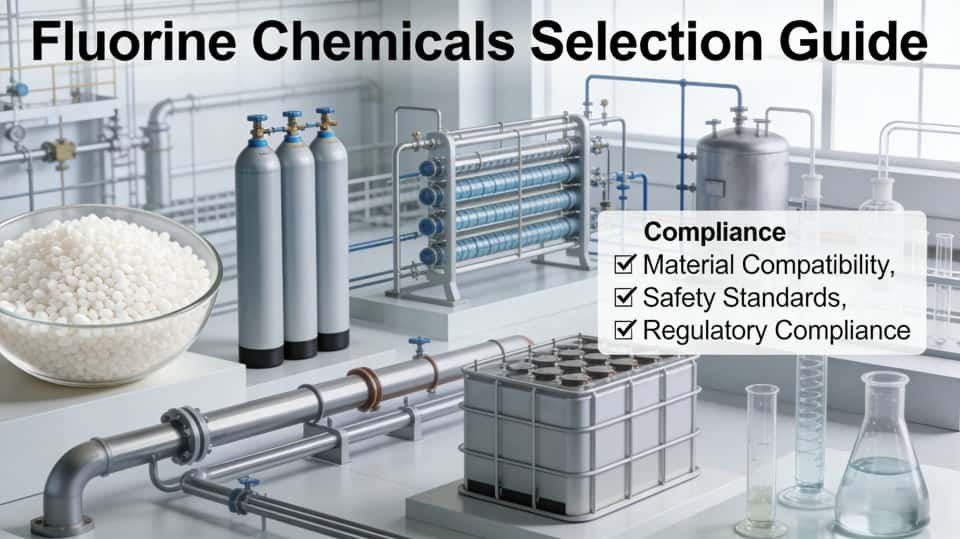
What Buyers and Product Developers Should Check
If you are evaluating a fluorine-containing product or raw material, the right questions are usually not “does it contain fluorine?” but rather:
Does fluorine deliver the exact property the product needs?
Is the fluorine-containing chemistry stable in the intended use environment?
What regulatory or environmental constraints apply to this chemistry and destination market?
What purity, processing, and packaging specifications matter?
Are there realistic non-fluorinated alternatives, or is fluorine still the best technical fit?
Those questions matter because fluorine is not a branding label; it is a performance tool. In some products it is essential. In others it is optional. In still others it is being reevaluated because regulations or sustainability priorities are changing.
Final Thoughts
So, what products use fluorine? The real answer is: far more products than most people realize. Fluorine appears in toothpaste and professional dental products, nonstick cookware, industrial hoses and seals, cable insulation, pharmaceutical products, agrochemicals, refrigerants, semiconductor-manufacturing gases, lithium-ion batteries, corrosion-resistant linings, and specialty water- and oil-repellent surface treatments. Its role changes from product to product, but the underlying reason is consistent: fluorine helps chemists and engineers create performance that is difficult to achieve otherwise.
That is why fluorine remains commercially important across both everyday products and advanced industrial systems. Sometimes it protects teeth. Sometimes it keeps food from sticking. Sometimes it lets a battery last longer, a chip fab run cleaner, a chemical line resist corrosion, or a drug molecule behave better in the body. Seen this way, fluorine is not one product story. It is a cross-industry performance platform.
If You’re Evaluating Fluorine-Based Products, Let’s Discuss the Right Fit
If your business is sourcing fluorinated intermediates, fluoropolymer-related materials, specialty fluorochemicals, or application-specific fluorine solutions, product selection should start with performance requirements, compliance needs, and process realities—not just a catalog name.
At Sparrow Chemicals, we work with customers who need practical fluorochemical support for real industrial applications, from specialty synthesis to materials selection and product matching.
Contact Sparrow Chemicals
https://sparrow-chemical.com/