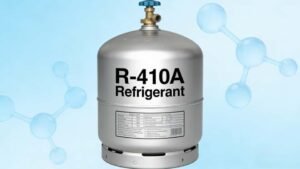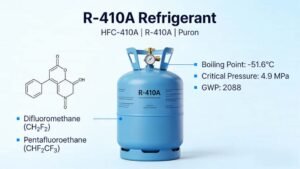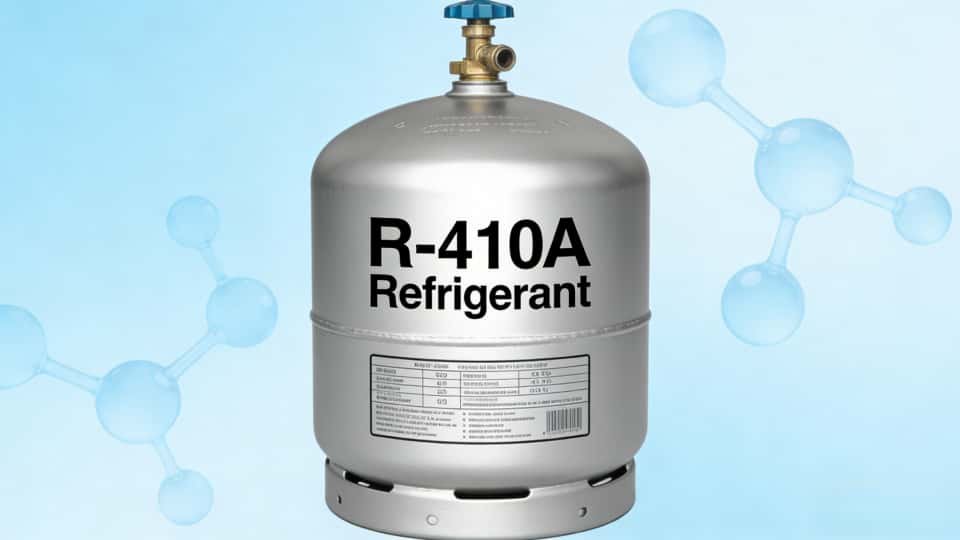
Refrigeration systems using R-404A are widely deployed in commercial cold storage, supermarket freezers, and transport refrigeration—but many operators only understand the system at a surface level. When problems arise—such as efficiency loss, high discharge pressure, poor cooling performance, or regulatory compliance issues—they often stem from an incomplete understanding of how R-404A actually works inside the refrigeration cycle. Without that understanding, maintenance becomes reactive instead of controlled, and system optimization becomes guesswork instead of engineering.
R-404A works by circulating through a closed-loop refrigeration system where it repeatedly evaporates and condenses to absorb heat from a cold space and release it elsewhere. As a blended HFC refrigerant (R-125, R-134a, R-143a), it absorbs heat during low-pressure evaporation in the evaporator and releases heat during high-pressure condensation in the condenser, driven by a compressor that maintains pressure and phase changes. Its thermodynamic properties make it especially suitable for low- and medium-temperature refrigeration applications.
To fully understand R-404A, it is essential to break down not just the refrigeration cycle, but also the blend behavior, thermodynamic characteristics, system interactions, and real-world operating implications. This guide provides a complete technical explanation for engineers, buyers, and refrigeration professionals.
Chemical Composition and Blend Behavior of R-404A
R-404A is a zeotropic refrigerant blend, meaning it consists of multiple components with slightly different boiling points.
Composition Breakdown
- R-125 (44%) – Non-flammable, stabilizes mixture
- R-134a (4%) – Improves thermodynamic balance
- R-143a (52%) – Provides strong cooling capacity
Key Characteristics of the Blend
- Near-azeotropic behavior (minimal temperature glide ~0.5°C)
- Stable composition during operation if properly handled
- Requires liquid charging to avoid fractionation
Table 1: Basic Properties of R-404A
| Property | Value / Description |
|---|---|
| Refrigerant Type | HFC blend |
| Composition | R-125 / R-134a / R-143a |
| ODP | 0 |
| GWP | ~3922 |
| Temperature Glide | Very low (~0.5°C) |
| Safety Class (ASHRAE) | A1 (non-flammable) |
Practical Insight
Because R-404A is a blend, improper handling (e.g., vapor charging or leaks) can alter composition, affecting performance.
The Refrigeration Cycle: How R-404A Transfers Heat
At its core, R-404A works through a vapor-compression refrigeration cycle, which consists of four main components:
- Compressor
- Condenser
- Expansion device
- Evaporator
Cycle Overview
R-404A continuously cycles through these stages:
- Compression
- Condensation
- Expansion
- Evaporation
Table 2: Refrigeration Cycle Stages
| Stage | Process Type | Key Function |
|---|---|---|
| Compressor | Compression | Increases pressure and temperature |
| Condenser | Heat rejection | Releases heat to environment |
| Expansion Valve | Pressure drop | Lowers pressure and temperature |
| Evaporator | Heat absorption | Absorbs heat from cooled space |
Key Principle
- Evaporation absorbs heat
- Condensation releases heat
This continuous phase-change cycle is what enables refrigeration.
Detailed Working Mechanism of R-404A in Each Stage
Understanding each stage in detail reveals how R-404A actually performs in real systems.
Compression Stage
- R-404A enters compressor as low-pressure vapor
- Compressor increases pressure and temperature
- Output becomes high-pressure superheated vapor
Engineering Impact:
- Requires robust compressor design
- High discharge temperatures must be controlled
Condensation Stage
- High-pressure vapor enters condenser
- Heat is rejected to air or water
- Refrigerant condenses into high-pressure liquid
Key Factors:
- Condenser efficiency affects system performance
- Ambient temperature influences pressure levels
Expansion Stage
- Liquid passes through expansion valve
- Sudden pressure drop occurs
- Partial flash evaporation lowers temperature
Result:
- Cold, low-pressure mixture enters evaporator
Evaporation Stage
- R-404A absorbs heat from the environment
- Fully evaporates into vapor
- Returns to compressor
Critical Role:
- Determines cooling capacity
- Influenced by airflow and load conditions
Thermodynamic Performance Characteristics
R-404A is optimized for low-temperature refrigeration.
Key Performance Features
- High cooling capacity
- Stable operation at low temperatures
- Good heat transfer properties
Table 3: Performance Comparison
| Parameter | R-404A | R-134a |
|---|---|---|
| Cooling Capacity | High | Moderate |
| Low-temp performance | Excellent | Limited |
| Efficiency | Moderate | Higher |
| GWP | Very High | High |
Typical Applications
- Supermarket freezers
- Cold storage
- Transport refrigeration
Pressure–Temperature Relationship and System Behavior
R-404A operates at relatively high pressures, especially in low-temperature systems.
Key Relationships
- Higher pressure → higher temperature
- Lower pressure → lower boiling point
Operational Implications
- Accurate pressure control is essential
- System design must match refrigerant characteristics
Table 4: Typical Operating Conditions
| Parameter | Value Range |
|---|---|
| Evaporating Temp | -40°C to -10°C |
| Condensing Temp | 30°C to 50°C |
| Pressure Level | Moderate–High |
Lubrication, Oil Compatibility, and System Requirements
R-404A requires specific lubrication systems.
Key Requirements
- Uses POE (polyolester) oil
- Highly sensitive to moisture
- Requires clean, dry systems
Table 5: Lubrication Compatibility
| Oil Type | Compatibility |
|---|---|
| Mineral Oil | Not suitable |
| POE Oil | Required |
Practical Considerations
- Moisture control is critical
- Proper evacuation during installation
Environmental Impact and Regulatory Challenges
R-404A has very high GWP (~3922), making it one of the most regulated refrigerants.
Environmental Issues
- Significant greenhouse gas impact
- Increasing regulatory restrictions
Global Regulations
- EU F-Gas Regulation
- U.S. AIM Act
- Kigali Amendment
Table 6: Regulatory Status
| Region | Status |
|---|---|
| EU | Strong phase-down |
| USA | Gradual reduction |
| Global | Long-term phase-out |
Alternatives to R-404A and Industry Transition
Due to regulatory pressure, alternatives are rapidly emerging.
Main Alternatives
- R-448A / R-449A (lower GWP blends)
- CO₂ (R-744) systems
- Hydrocarbon refrigerants
Table 7: R-404A vs Alternatives
| Refrigerant | GWP | Efficiency | Status |
|---|---|---|---|
| R-404A | 3922 | Moderate | Phasing out |
| R-448A | ~1387 | Higher | Replacement |
| CO₂ | 1 | High | Growing use |
Common Operational Issues and Troubleshooting
Understanding how R-404A works helps diagnose problems.
Typical Issues
- High discharge pressure
- Poor cooling performance
- Oil return problems
- Fractionation due to leaks
Root Causes
- Incorrect charging
- System contamination
- Component mismatch
Practical Tips
- Always charge as liquid
- Monitor pressure and temperature
- Maintain proper system sealing
Conclusion: Understanding R-404A as a System, Not Just a Refrigerant
R-404A is more than a refrigerant—it is part of a dynamic thermodynamic system. Its effectiveness depends on:
- Proper system design
- Accurate handling
- Understanding of phase-change behavior
- Awareness of regulatory trends
As the industry moves toward lower-GWP solutions, understanding R-404A provides a foundation for transitioning to next-generation refrigerants.
Let’s Optimize Your Refrigeration Strategy
At Sparrow Chemicals, we help customers not only source refrigerants like R-404A but also understand how they perform in real systems—from selection to compliance to future transition planning.
If you’re evaluating refrigerants or optimizing system performance, contact us:
👉 https://sparrow-chemical.com/