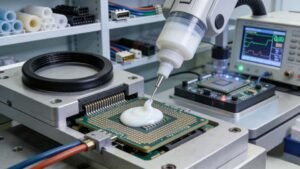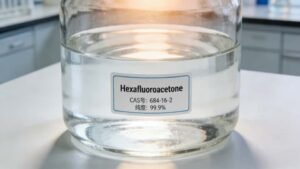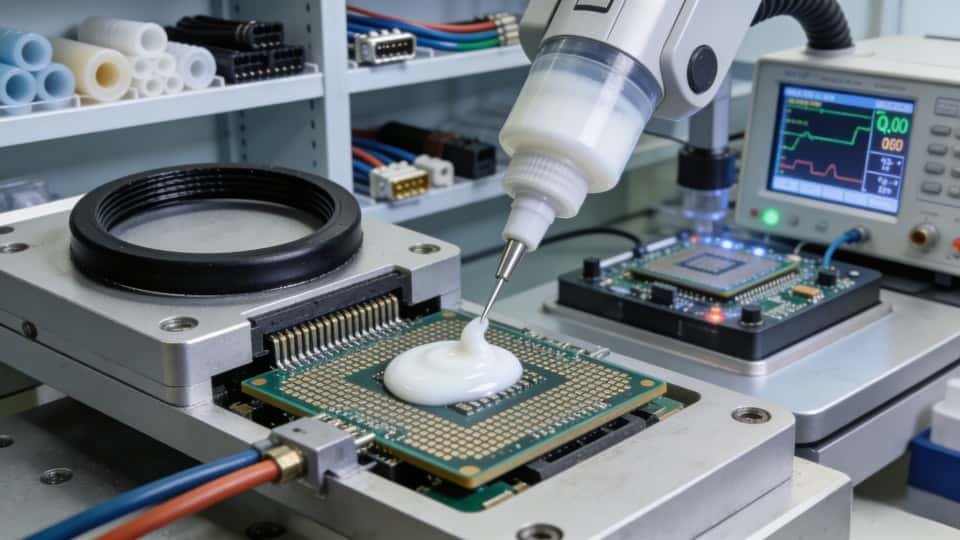
Electronic manufacturing today demands ultra-pure materials, atomic-scale surface control, and aggressive plasma chemistries. As semiconductor nodes shrink below 10 nm and advanced packaging technologies evolve, conventional hydrocarbon-based reagents increasingly fail to meet requirements for volatility, reactivity, residue control, and dielectric precision. The wrong fluorinated precursor can cause contamination, plasma instability, low selectivity, or unacceptable defect density—ultimately reducing yield and profitability. This is precisely where Hexafluoroacetone (HFA) becomes strategically important.
Hexafluoroacetone (CF₃COCF₃) is widely used in electronic chemicals as a high-reactivity fluorinated building block for plasma etch gases, fluorinated monomer synthesis, specialty dielectric materials, surface modification agents, and semiconductor-grade intermediates. Its strong electrophilicity, high volatility, and fluorine-rich structure enable the formation of ultra-low dielectric polymers, advanced fluorinated precursors, and high-purity etching chemistries essential for microelectronics manufacturing.
To fully understand how Hexafluoroacetone integrates into the electronics chemical value chain, we must examine its molecular behavior, derivative pathways, plasma compatibility, purity requirements, and industrial implementation across semiconductor and advanced electronic materials industries.
1. Molecular Characteristics That Make HFA Ideal for Electronic Chemicals
Hexafluoroacetone (HFA) possesses a highly electron-deficient carbonyl center flanked by two trifluoromethyl groups. This configuration delivers several performance advantages critical in semiconductor chemistry.
Key Molecular Properties
| Property | Value | Relevance to Electronics |
|---|---|---|
| Chemical Formula | C₃F₆O | Fully fluorinated carbonyl |
| Molecular Weight | 166.02 g/mol | Moderate volatility |
| Boiling Point | ~ -28°C | Gas-phase processing |
| Dipole Moment | High | Strong electrophilicity |
| Reactivity | Extremely reactive toward nucleophiles | Enables derivative synthesis |
| Hydrate Formation | Forms stable gem-diol | Controlled surface reactions |
The CF₃ groups exert strong -I inductive effects, increasing carbonyl electrophilicity. This enables controlled reactions with:
- Alcohols
- Amines
- Fluorinated olefins
- Silicon-containing intermediates
Such reactivity underpins its role in fluoropolymer and dielectric precursor synthesis.
2. Hexafluoroacetone in Semiconductor Plasma Etching Chemistry
Role in Etching Gas Development
Although HFA itself is not always directly used as the primary etching gas, it serves as a critical intermediate for generating fluorinated etch precursors and specialty plasma modifiers.
Why Fluorine Is Essential in Etching
In semiconductor fabrication, plasma etching relies on fluorine radicals to selectively remove:
- Silicon
- Silicon dioxide
- Silicon nitride
- Low-k materials
HFA derivatives help generate fluorinated compounds that:
- Enhance anisotropy
- Improve sidewall passivation
- Reduce micro-trenching
- Optimize selectivity
Comparative Plasma Performance Table
| Parameter | Traditional CF₄ | C₂F₆ | HFA-Derived Chemistry |
|---|---|---|---|
| Etch Selectivity | Moderate | Moderate | High (tailored) |
| Polymer Deposition Control | Limited | Moderate | Excellent |
| Residue Formation | Higher | Moderate | Lower |
| Process Tunability | Low | Moderate | High |
| Environmental Footprint | High GWP | High GWP | Tunable |
HFA-derived compounds enable precision in fluorine-to-carbon ratio engineering, critical for advanced nodes.
3. HFA as a Precursor for Ultra-Low-k Dielectric Materials
As interconnect dimensions shrink, reducing dielectric constant (k-value) becomes critical to minimize RC delay and signal cross-talk.
Why Fluorinated Dielectrics?
Fluorinated polymers provide:
- Low polarizability
- Reduced intermolecular interactions
- Lower dielectric constants
Hexafluoroacetone serves as a building block for synthesizing:
- Fluorinated polyimides
- Fluoroacrylates
- Perfluorinated monomers
- Crosslinkable fluoropolymers
Dielectric Comparison
| Material | Dielectric Constant (k) | Thermal Stability | Application |
|---|---|---|---|
| SiO₂ | 3.9 | High | Legacy nodes |
| Organosilicate glass | 2.7–3.0 | Moderate | 45–28 nm |
| HFA-derived fluoropolymers | 1.9–2.3 | High | Advanced nodes |
| Air gap | ~1.0 | Complex | 7 nm and below |
HFA enables polymer architectures that reduce k-values without compromising thermal stability.
4. HFA in Photoresist and Lithography Chemical Synthesis
Modern EUV lithography requires chemically amplified photoresists with extreme precision.
HFA contributes to:
- Fluorinated protecting groups
- Acid-labile monomers
- Surface-modifying additives
- Plasma-resistant topcoats
Fluorinated side chains reduce surface energy, improving:
- Coating uniformity
- Pattern fidelity
- Developer compatibility
This becomes particularly important in:
- 7 nm
- 5 nm
- 3 nm process nodes
5. Surface Treatment and Electronic Coating Applications
Hexafluoroacetone reacts with silanes and functional groups to create:
- Hydrophobic surface modifiers
- Anti-corrosion fluorinated coatings
- Electronic encapsulation materials
Performance Comparison
| Coating Type | Surface Energy (mN/m) | Moisture Resistance | Electronics Use |
|---|---|---|---|
| Epoxy | 42 | Moderate | PCB |
| Silicone | 24 | High | Encapsulation |
| HFA-modified fluoropolymer | 15–18 | Very High | Advanced electronics |
Low surface energy improves reliability in:
- Printed circuit boards
- Microelectromechanical systems (MEMS)
- Flexible electronics
6. Semiconductor-Grade Purity Requirements
Electronic chemicals demand extreme purity.
Semiconductor Grade Specifications
| Parameter | Required Level |
|---|---|
| Purity | ≥ 99.99% |
| Moisture | < 10 ppm |
| Metal Impurities | < 1 ppm total |
| Particle Count | Ultra-low |
| Residual Acidity | Controlled |
HFA must be handled under:
- Dry inert atmosphere
- Stainless steel passivated systems
- Moisture-free cylinder filling
Even trace contamination affects plasma stability and device yield.
7. Environmental and Regulatory Considerations
Fluorochemicals are heavily regulated.
HFA usage in electronics is carefully managed to ensure:
- Controlled emissions
- Recovery systems
- GWP mitigation
- Worker safety compliance
Many HFA derivatives are optimized to reduce environmental footprint compared to legacy perfluorocarbons.
8. Industrial Implementation and Supply Chain Integration
For semiconductor fabs, supply reliability is critical.
Key Requirements
- Stable batch consistency
- Semiconductor-grade certification
- REACH compliance
- Controlled transport (pressurized cylinders)
- Dedicated fluorochemical production lines
Manufacturers like Sparrow-Chemical provide:
- High-purity HFA
- Custom derivative synthesis
- Technical application support
- Scale-up capability
9. Emerging Trends: HFA in Next-Generation Electronics
Future applications include:
- Advanced packaging materials
- 3D integrated circuits
- Chiplet bonding materials
- Flexible fluorinated electronics
- Quantum device coatings
Fluorine-rich carbonyl intermediates such as HFA will continue enabling low-dielectric, high-stability, plasma-compatible materials.
Conclusion
Hexafluoroacetone is not merely a fluorinated ketone—it is a foundational building block in the electronic chemicals ecosystem. From plasma etch gas engineering to ultra-low-k dielectric polymer synthesis, from lithography additives to advanced surface treatments, HFA enables precision chemistry at atomic scales. Its high electrophilicity, volatility, and fluorine density make it indispensable in advanced semiconductor manufacturing.
As device geometries shrink and performance requirements intensify, the demand for high-purity, high-reactivity fluorinated intermediates like Hexafluoroacetone will only grow.
Ready to Source Semiconductor-Grade Hexafluoroacetone?
If you are developing advanced electronic chemicals, plasma etch precursors, fluorinated dielectric materials, or next-generation semiconductor formulations, precision raw material selection is critical.
At Sparrow-Chemical, we supply high-purity Hexafluoroacetone with controlled moisture levels, strict impurity management, and consistent batch reliability tailored for electronic-grade applications.
Contact us today at:
👉 https://sparrow-chemical.com/
Let’s build your next breakthrough in electronic chemistry—reliably, safely, and with uncompromising quality.