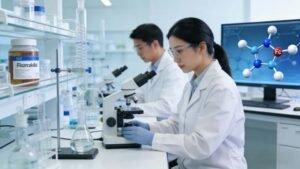
Chipmakers face a brutal engineering reality: as device geometries shrink, tolerance for contamination, profile error, residue, and line-edge variability collapses. A chemistry set that worked well enough at older nodes can become unacceptable when the process window narrows, aspect ratios rise, and every parasitic defect threatens yield. In that environment, fluorochemicals are not a niche add-on. They are part of the enabling chemistry that helps fabs etch, clean, strip, deposit, protect, and transport critical materials with the precision modern semiconductor manufacturing demands. Without the right fluorinated gases, fluoropolymer flow paths, and fluorinated materials in lithography-related systems, fabs would struggle to maintain throughput, pattern fidelity, and chamber cleanliness at advanced nodes. This is why understanding fluorochemicals in semiconductors is not just a chemistry question, but a yield, cost, reliability, and scaling question.
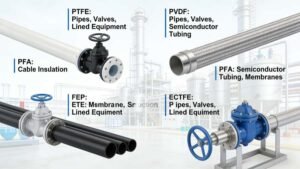
Fluorochemicals are essential in semiconductor manufacturing because they enable highly selective plasma etching, chamber cleaning, residue control, high-purity chemical transport, and materials compatibility in aggressive fab environments. Fluorinated gases such as CF₄, C₂F₆, CHF₃, C₄F₈, SF₆, WF₆, and NF₃ are used across dry etch, dielectric patterning, tungsten deposition, and chamber clean operations, while fluoropolymers such as PTFE, PFA, FEP, and ECTFE are used in tubing, fittings, seals, liners, and wet-process equipment because of their chemical resistance and cleanliness performance. At the same time, the industry is under increasing pressure to reduce emissions and replace high-impact PFAS-related materials where possible, so the future of fluorochemicals in semiconductors is shifting toward higher efficiency, better abatement, and lower-environmental-burden process chemistries.
To see why fluorochemicals are so deeply embedded in chip manufacturing, it helps to stop thinking of them as one product category. In a semiconductor fab, “fluorochemicals” span several functional families: plasma etch gases, chamber clean gases, fluorinated deposition precursors, fluorinated polymers for ultra-pure fluid handling, and fluorinated functional materials associated with patterning and contamination control. Each family solves a different manufacturing problem, but they are linked by the same fundamental advantage: fluorine chemistry gives engineers access to extreme reactivity when they want controlled material removal, and exceptional inertness when they want purity, corrosion resistance, and long equipment life. That unusual combination is exactly why fluorine chemistry sits at the core of modern semiconductor process integration.
Why fluorine chemistry fits semiconductor manufacturing so well
The semiconductor industry needs two opposite things at the same time. In one context, it needs a chemistry that can attack a solid film aggressively, directionally, and selectively under plasma conditions. In another context, it needs a material that will not react, swell, leach, or corrode while carrying ultra-pure acids, solvents, DI water, or process chemicals through a fab. Fluorine-based chemistry can serve both ends of that spectrum.
At the process level, many dry etch operations depend on fluorine radicals or fluorine-containing plasma fragments because they react efficiently with silicon-containing materials, silicon dioxide, silicon nitride, and various dielectric stacks. The exact gas blend determines whether the plasma behaves more chemically, more physically, more polymerizing, or more selective. That is why fabs do not use “one fluorinated gas” for etching. They use engineered gas mixtures, often tuning fluorocarbon-to-oxygen balance, ion energy, pressure, and source conditions to shape sidewall passivation, anisotropy, selectivity, and etch rate. EPA technical descriptions of semiconductor manufacturing specifically identify etching as a process that uses plasma-generated fluorine atoms and other reactive fluorine-containing fragments to selectively remove exposed films or substrate material, and identify chamber cleaning as another major fluorine-driven operation.
At the equipment-materials level, fluoropolymers matter because fabs handle some of the most aggressive chemical environments in manufacturing: hydrofluoric-acid-based blends, oxidizers, solvent systems, ultrapure acids, and specialty chemicals that can quickly degrade conventional polymers or contaminate a high-purity system. Specialty fluoropolymers such as ECTFE, PTFE, and PFA are used because they combine broad chemical resistance with smooth surfaces, good cleanability, and suitability for high-purity applications. Solvay states that Halar® ECTFE is resistant to the full range of semiconductor chemicals and solvents and is suitable for ultrapure components, while AGC has long positioned ultrapure PFA grades for semiconductor manufacturing equipment on the basis of very low extractable metal contamination.
That duality is the first key to understanding fluorochemicals in semiconductors: fluorine can be the chemistry that removes material from a wafer, and fluorinated polymers can be the material that safely transports the chemicals used around that wafer.
Where fluorochemicals appear across a semiconductor fab
A modern fab uses fluorochemicals in far more places than many buyers initially expect. The obvious category is process gases, but in practice fluorochemicals show up across dry process, wet process, tool infrastructure, gas delivery, liquid delivery, and materials integration.
The following framework helps separate the roles more clearly.
| Fluorochemical family | Typical examples | Main fab function | Why it matters |
|---|---|---|---|
| Plasma etch gases | CF₄, CHF₃, C₂F₆, C₄F₈, SF₆ | Pattern transfer, dielectric etch, silicon etch, profile control | Selectivity, anisotropy, residue control |
| Chamber clean gases | NF₃, CF₄, F₂-based approaches | Remove deposited films from CVD chamber walls | Tool uptime, defect reduction, stable process conditions |
| Fluorinated deposition-related gases | WF₆ and related fluorinated chemistries | Tungsten-related deposition steps and specialty process integration | Film formation and integration flexibility |
| Fluoropolymers in fluid handling | PTFE, PFA, FEP, ECTFE | Tubing, fittings, liners, tanks, wet benches, seals | Chemical resistance, purity, low contamination |
| Patterning-related fluorinated materials | Fluorinated additives, surfactant-like components, specialized polymers | Wetting control, resist-related performance, surface behavior | Finer feature formation and process stability |
| Environmental control and abatement interface | F-gases plus abatement systems | Emissions reduction, destruction/removal | Compliance and sustainability |
This table simplifies a messy reality, but it captures the point: fluorochemicals are not confined to one toolset. They participate in the process architecture of the fab. EPA documentation on electronics manufacturing specifically discusses semiconductor use of high-global-warming-potential fluorinated compounds, and Merck’s recent semiconductor materials portfolio also highlights advanced fluorinated metal gases and new selective fluorocarbon etch gases for advanced semiconductor manufacturing.
For procurement teams, the practical lesson is that “fluorochemical demand from semiconductor customers” can come from very different buyer profiles. One customer may care about ultra-tight control of etch rate and sidewall polymer behavior. Another may care about extractables from PFA tubing. Another may focus on lower-emission chamber clean chemistry. Another may be looking for fluorinated materials that survive harsh wet clean environments. Treating all of these as one generic market usually leads to weak positioning.
Fluorinated gases in plasma etching: the real workhorses of pattern transfer
Dry etching is one of the most important places fluorochemicals earn their keep. Semiconductor etch is fundamentally a controlled competition between chemistry and ion-driven directionality. Fluorine-containing gases are central because many relevant films form volatile reaction products with fluorine under plasma conditions. That makes fluorine chemistry powerful for material removal, but the real sophistication lies in tuning the plasma so it removes the right material, at the right rate, in the right direction, while leaving adjacent layers sufficiently protected.
Different fluorinated gases support different process behaviors. CF₄ is a foundational fluorocarbon etch gas and fluorine source. CHF₃ can introduce a different polymerization balance and is often associated with selective oxide-related etch behavior. C₄F₈ is well known in advanced plasma etch because it contributes sidewall passivation behavior in certain highly anisotropic etch regimes. SF₆ is widely associated with silicon etching because it can generate fluorine-rich plasma conditions favorable for fast silicon removal. C₂F₆ and related perfluorocarbons also appear in various etch and clean contexts. Semiconductor process documentation and environmental reporting frameworks consistently identify these fluorinated gases as core inputs to etch and clean operations.
What matters in practice is not just the molecule itself, but what it does in plasma. Engineers think in terms such as free-fluorine availability, polymer deposition tendency, dissociation behavior, chamber condition sensitivity, and byproduct formation. A fluorochemical supplier that speaks only in purity percentages but cannot discuss process implications is usually not speaking the customer’s language.
The comparative logic below is more useful for industrial readers.
| Gas | General plasma tendency | Typical semiconductor relevance | Main trade-off |
|---|---|---|---|
| CF₄ | Strong fluorine source, relatively classic etch chemistry | Dielectric and general plasma etch uses | Emissions burden if not well controlled |
| CHF₃ | More balanced etch/passivation behavior in some regimes | Oxide/selective etch applications | Can create more complex residue/profile behavior |
| C₂F₆ | Fluorine-rich fluorocarbon gas | Etch and clean roles | High GWP, abatement pressure |
| C₄F₈ | More polymerizing fluorocarbon in many applications | Advanced anisotropic etch and passivation support | Residue and chamber conditioning sensitivity |
| SF₆ | Highly effective fluorine donor for silicon-rich etch contexts | Silicon etch, MEMS-related or high-rate silicon removal contexts | Very high GWP |
| NF₃ | Strong chamber-clean relevance more than classic profile etch | Remote plasma or chamber cleaning | Still high GWP despite efficiency advantages |
The reason fabs continue using multiple fluorinated gases instead of “standardizing” on one cheaper option is simple: feature geometry, film stack, selectivity target, and downstream clean requirements all change the optimum chemistry. As critical dimensions shrink and three-dimensional architectures become more demanding, the value of tailored fluorocarbon chemistry rises rather than falls.
A second important point is that etch gases do not operate in isolation. O₂, Ar, H₂, and non-fluorinated co-reactants may be added to modify polymer balance, radical density, ion energy distribution, and post-etch residue. So when a fab buys a fluorochemical for etch, it is buying a process behavior, not just a molecule.
Chamber cleaning: the less glamorous but absolutely essential fluorochemical application
If etching is the high-profile application, chamber cleaning is the operational backbone. Deposition tools gradually accumulate films on chamber walls, showerheads, liners, and internal surfaces. If those deposits are not removed efficiently and reproducibly, the chamber drifts, particles increase, maintenance intervals worsen, and yield suffers. Fluorinated cleaning chemistries are widely used because plasma-generated fluorine species can react with deposited films and convert them into removable volatile byproducts.
EPA descriptions of semiconductor process emissions explicitly identify CVD chamber cleaning as a major fluorinated-gas use case and define it as cleaning deposition chambers periodically with plasma-generated fluorine atoms and other reactive fluorine-containing fragments. NF₃ has become especially important in this space because the industry has used it to improve cleaning efficiency relative to older options in many applications, although it still carries a very high global warming burden and must be managed carefully. EPA supplier profiles note that NF₃, while still high in GWP, has lower GWP than SF₆ and is often used more efficiently; they also describe industry work on F₂ substitution and other process improvements.
This creates a useful commercial distinction for suppliers and content marketers. Not all fluorochemical value in semiconductors is tied to wafer-facing critical etch performance. Some of the highest customer pain may sit in uptime, chamber turnaround, maintenance burden, and emissions optimization. A supplier who can help a customer think through clean efficiency, gas utilization, byproduct formation, abatement compatibility, and lifecycle emissions can sound far more credible than a supplier who only says “we provide high-purity NF₃.”
The operational comparison below is often how fabs think about the issue.
| Chamber cleaning concern | Why it matters | Role of fluorochemical choice |
|---|---|---|
| Cleaning completeness | Residual film can shift next runs | Determines fluorine availability and reaction efficiency |
| Cleaning speed | Directly affects uptime | Higher utilization chemistry can reduce clean time |
| Tool stability after clean | Poor conditioning causes drift | Gas choice affects chamber surface state |
| Emissions burden | Compliance and cost issue | Some gases have lower GWP or higher utilization than others |
| Abatement performance | Required for sustainability targets | Process gas and byproduct mix affects destruction/removal design |
Applied Materials and Lam Research both frame fluorinated process gas emissions and gas abatement as active sustainability and technology topics in their recent reporting, reinforcing that fluorochemical choice is now inseparable from emissions strategy.
For article readers, the takeaway is straightforward: in semiconductors, fluorochemicals are not valuable only because they make chips possible. They are valuable because they keep tools running reproducibly enough to manufacture chips economically.
Fluoropolymers in semiconductor equipment: the quiet infrastructure behind purity and corrosion resistance
When people think about semiconductors, they tend to picture wafers, EUV scanners, and plasma tools. They often overlook the fluid path infrastructure surrounding the process. Yet semiconductor production depends on extraordinarily clean handling of liquids and gases, and that means tubing, hose cores, valve seats, fittings, vessel linings, wet benches, and pump-adjacent components must survive aggressive chemistry while minimizing particle generation and contamination.
This is where fluoropolymers become indispensable. PTFE and PFA are widely used in high-purity fluid systems because they offer broad chemical compatibility and low interaction with transported fluids. Swagelok describes PTFE and PFA hose options for high-purity and semiconductor production environments, while PFA fittings are positioned for the thermal stability, creep resistance, and application suitability required in high-purity production. Solvay positions ECTFE for the full range of semiconductor chemicals and solvents, specifically noting its suitability for ultrapure components and low particle hang-up potential.
That matters more than it might seem. In a fab, the wrong material of construction can create at least four major problems at once: chemical attack, ionic contamination, particle shedding, and premature maintenance. Even a tiny contamination event can damage yield when processes are operating at advanced geometries. So the “materials around the process” deserve almost as much scrutiny as the process chemistry itself.
A more practical comparison looks like this.
| Fluoropolymer/material | Typical semiconductor relevance | Main strength | Main caution |
|---|---|---|---|
| PTFE | Tubing, hose cores, chemical-compatible flow paths | Excellent chemical resistance | Mechanical design must account for flexibility/permeation context |
| PFA | High-purity tubing, fittings, molded components | Purity, smooth surfaces, chemical resistance | Cost and application-specific thermal/mechanical limits |
| FEP | Some chemical handling and liner applications | Processability and chemical resistance | Must be chosen against exact chemical/temperature profile |
| ECTFE | Wet process equipment, chemical service components | Broad resistance and strong mechanical package | Application fit depends on purity and fabrication requirements |
| Metal alloys | Where pressure/temperature/mechanical strength dominate | Structural robustness | Can be inferior in some corrosive, contamination-sensitive wet chemistries |
In website content and B2B sales, this is an important messaging opportunity. Many suppliers stop at the phrase “excellent chemical resistance.” Semiconductor buyers usually need more granular language: high purity, low extractables, surface smoothness, cleanability, low particle retention, compatibility with specific acids and solvents, and long service life under semiconductor wet-processing conditions. That is what makes the content sound closer to fab reality.
Etch and clean get most of the attention, but fluorinated chemistry also appears in deposition-related process flows and specialty gas portfolios. One notable example is tungsten chemistry, where fluorinated tungsten precursors such as WF₆ have long been relevant to semiconductor processing. More broadly, semiconductor materials suppliers continue to highlight advanced fluorinated metal gases and selective fluorocarbon etch gases in next-generation manufacturing portfolios. Merck’s 2025 semiconductor materials brochure explicitly references advanced fluorinated metal gases and new selective fluorocarbon etch gases for advanced semiconductor manufacturing, which shows that fluorinated gas innovation is still active, not mature and stagnant.
This matters because semiconductor scaling is no longer a simple “make it smaller” exercise. Integration now involves gate-all-around structures, complex memory architectures, high-aspect-ratio features, advanced packaging, heterogeneous integration, and increasingly narrow defect budgets. In that environment, specialty gas suppliers are not only selling a commodity; they are selling process window expansion.
That has two strategic implications for a chemical supplier or content platform. First, the semiconductor fluorochemical market is not just about legacy bulk gases. It increasingly includes highly engineered, application-specific chemistries tied to selective etch, advanced deposition, and integration challenges. Second, customers are more likely to reward suppliers who can speak about process outcomes—selectivity, profile control, storage stability, residue suppression, gas delivery safety—rather than just list chemical names.
A simplified mapping is useful here.
| Process zone | Fluorochemical relevance | Customer value driver |
|---|---|---|
| Plasma etch | Fluorocarbon gases and blends | Pattern fidelity, selectivity, profile control |
| Chamber clean | NF₃, F₂-related approaches, fluorinated clean chemistries | Uptime, maintenance interval, emissions efficiency |
| Tungsten-related deposition | Fluorinated tungsten precursors | Film formation and process integration |
| Gas storage/delivery | Specialty packaging and safe delivery architecture for reactive gases | Safety, utilization, reduced waste |
| Next-generation selective processes | New selective fluorocarbon gases | Better process windows at advanced nodes |
For industrial SEO and lead generation, this suggests a strong content angle: buyers searching “fluorochemicals in semiconductors” are often not looking only for a definition. Many are actually trying to understand where value is created and where the technology is moving.
Lithography, surface control, and the PFAS challenge in semiconductor materials
Another area worth addressing carefully is lithography and resist-related materials. The semiconductor industry has long used fluorinated chemistries not only in gases and equipment materials but also in certain patterning-related formulations where surface properties matter. Fluorinated components can help influence wetting, surface energy, compatibility, and process control. At the same time, this is precisely one of the areas now under intense environmental and regulatory pressure because many fluorinated materials can fall into or intersect with the broad PFAS discussion.
This is no longer a theoretical issue. Imec reported in 2025 that it is actively working to remove PFAS from semiconductor manufacturing, from resists to rinses, and stated that first results show high-resolution patterns with PFAS-free chemically amplified EUV photoresists, although performance challenges remain. That is an important signal: fluorinated materials have delivered real technical value to semiconductor patterning, but the industry is now investing seriously in alternatives.
For a technical audience, the right interpretation is not “fluorochemicals are disappearing from semiconductor manufacturing.” The better interpretation is more nuanced:
fluorochemicals remain highly important;
their value in certain applications is still difficult to replace;
but environmental, regulatory, and customer pressure is forcing re-evaluation of where fluorinated chemistry is essential versus merely convenient.
That leads to a very useful decision lens.
| Application context | Why fluorinated chemistry was favored | Why it is being reconsidered |
|---|---|---|
| Etch gases | Strong process performance and controllability | Emissions and abatement burden |
| Chamber clean | High efficiency and mature integration | High GWP concerns |
| Resist/surface-control materials | Surface-energy and patterning advantages | PFAS-related restrictions and substitution pressure |
| Equipment polymers | Corrosion resistance and purity | End-of-life, environmental scrutiny, material policy pressure |
This section is commercially important because many industrial websites oversimplify the PFAS issue. Serious semiconductor buyers do not respond well to simplistic claims like “PFAS-free is the future” or “fluoropolymers are irreplaceable forever.” What they want is evidence that the supplier understands the balance between performance necessity and substitution pressure.
The sustainability problem: why semiconductor fluorochemicals are under pressure
If one topic has changed the fluorochemical conversation in semiconductors over the last decade, it is emissions. Many semiconductor fluorinated gases have extremely high global warming potential. EPA explicitly states that semiconductor manufacturing uses a variety of high-GWP fluorinated compounds and has supported voluntary industry efforts to reduce those emissions. Its electronics manufacturing greenhouse-gas reporting materials also detail how semiconductor facilities calculate annual emissions for each input gas and byproduct gas.
This means fluorochemicals in semiconductors now sit at the intersection of process performance and climate accountability. A gas may be technically excellent, but if utilization is poor, abatement is weak, or alternatives are emerging, fabs have a strong incentive to reduce its footprint. That pressure affects purchasing, process engineering, tool design, and supplier innovation.
The main response levers are usually some combination of the following:
higher process efficiency;
better gas utilization;
substitution toward lower-impact chemistry where feasible;
remote plasma clean architectures that improve utilization;
point-of-use abatement;
capture or recycle approaches in selected cases;
and fab-level emissions measurement and reporting discipline.
EPA supplier and technical documents show examples of these approaches, including movement from some legacy chemistries toward NF₃ in certain cleaning contexts for better efficiency, exploration of F₂ substitution in some cases, and the use of destruction/removal technologies and measurement protocols.
A useful strategic table looks like this.
| Sustainability lever | What it does | Impact on fluorochemical strategy |
|---|---|---|
| Gas substitution | Replaces one fluorinated gas with another or a different chemistry | May lower GWP or improve utilization |
| Process optimization | Uses less gas for same result | Reduces cost and emissions intensity |
| Remote plasma cleaning | Improves gas dissociation/utilization in some scenarios | Can reduce waste and improve clean efficiency |
| Abatement systems | Destroys/removes fluorinated exhaust gases/byproducts | Essential for compliance and ESG goals |
| Alternative materials R&D | Reduces dependence on PFAS-related materials | Longer-term structural change |
For content marketing, this is often the most powerful section because it aligns with what fab stakeholders are actually discussing internally: not whether fluorochemicals are useful, but how to keep the benefits while reducing regulatory and emissions risk.
How semiconductor buyers evaluate fluorochemicals in practice
A semiconductor customer does not usually buy fluorochemicals based on a generic brochure. The evaluation framework is much stricter. Buyers typically care about a combination of chemistry, purity, stability, packaging, analytical support, and supply continuity. The more advanced the application, the less tolerant the customer will be of vague claims.
A realistic semiconductor procurement mindset often includes the following questions:
Is the chemical purity sufficient for the intended node and process window?
What are the metallic impurity limits?
How stable is the gas or liquid during storage and delivery?
Does the supplier understand cylinder, drum, or bulk packaging compatibility?
Can the supplier provide relevant analytical data, certificate structure, and quality documentation?
How does the chemical interact with existing tool materials and abatement systems?
What is the consistency from lot to lot?
What is the supplier’s view on emissions, safety, and regulatory developments?
That is why industrial suppliers entering the semiconductor-adjacent fluorochemical market should avoid commodity-style messaging. The language has to be closer to application engineering.
The comparison below is a practical checklist.
| Buyer concern | What the customer is really asking |
|---|---|
| Purity | Will this introduce yield-killing contamination? |
| Moisture/trace impurities | Will this shift plasma behavior or damage the process window? |
| Packaging integrity | Can this material be delivered safely and reproducibly? |
| Lot consistency | Will our tool tuning remain stable across deliveries? |
| Materials compatibility | Will this attack seals, tubing, valves, or liners? |
| Abatement compatibility | Will this create downstream emissions or byproduct problems? |
| Documentation | Can this pass internal quality and supplier qualification review? |
| Supply resilience | Can we rely on this source during demand spikes or geopolitical stress? |
For a website serving semiconductor chemical buyers, publishing content around these questions is often more commercially valuable than publishing only “what is X chemical?” definitions.
Semiconductor fluorochemical product positioning: what suppliers often get wrong
Many chemical suppliers entering semiconductor-related marketing make three recurring mistakes.
The first is over-broad positioning. They describe themselves as a supplier of “all fluorochemicals for the semiconductor industry,” but provide no segmentation between etch gases, clean gases, fluoropolymer materials, and specialty process chemistries. To a technical buyer, that sounds imprecise.
The second is under-technical messaging. They focus on generic product virtues such as “high quality,” “stable supply,” and “competitive price,” while failing to address purity, contamination control, process fit, abatement implications, or materials compatibility.
The third is ignoring the environmental narrative. In 2026, a semiconductor fluorochemical supplier that says nothing about emissions, PFAS pressure, abatement, or substitution pathways sounds outdated.
A stronger positioning model looks more like this:
| Weak positioning | Strong positioning |
|---|---|
| “We supply fluorochemicals for semiconductors.” | “We support semiconductor process chemistry and high-purity materials needs across etch, chamber clean, ultra-pure fluid handling, and specialty fluorinated process materials.” |
| “High quality and good price.” | “Controlled purity, application-oriented selection, and support for materials compatibility, packaging, and emissions-aware process integration.” |
| “Used in electronics industry.” | “Relevant to semiconductor dry etch, chamber cleaning, wet-process chemical handling, and advanced materials workflows.” |
| No sustainability discussion | Explicit awareness of GWP, abatement, and PFAS transition pressure |
This does not mean every supplier must pretend to be a top-tier semiconductor process company. It means the messaging must reflect how serious buyers think.
Risks, safety, and compliance realities
Fluorochemicals in semiconductors are powerful because they are reactive, persistent, or highly resistant—sometimes all three depending on the chemistry class. That also means safety, environmental handling, and regulatory discipline cannot be treated as an afterthought.
Process gases may be toxic, corrosive, oxidizing, or hazardous under pressure. Some fluorinated gases have extremely high GWP. Some fluoropolymer materials or PFAS-related formulations raise end-of-life or regulatory questions. Semiconductor equipment makers and fabs therefore operate inside a layered governance environment that includes process safety management, gas cabinet and delivery design, leak detection, abatement, waste treatment, and emissions reporting. Lam Research notes its long involvement with SEMI EHS guidelines for semiconductor manufacturing equipment, and EPA maintains industry-specific frameworks for semiconductor emissions reduction and reporting.
For chemical suppliers, this has a direct commercial consequence: documentation is not optional. Buyers may expect SDS support, impurity specifications, packaging and storage guidance, transport information, and enough process understanding to avoid inappropriate application recommendations.
A concise risk map is helpful.
| Risk category | Example concern | Supplier implication |
|---|---|---|
| Process safety | Reactive or toxic gas handling | Strong packaging, storage, and handling documentation |
| Environmental impact | High-GWP fluorinated gas emissions | Clear position on abatement and efficiency |
| Product stewardship | PFAS-related customer concern | Honest application-specific guidance |
| Contamination | Trace metals, moisture, particles | Tight quality control and analytical support |
| Regulatory change | Restrictions, reporting, customer policy updates | Ongoing monitoring and communication |
The suppliers most likely to win trust are the ones who acknowledge these risks clearly instead of hiding them behind sales language.
Where the market is heading next
The future of fluorochemicals in semiconductors is not a simple growth story or a simple decline story. It is a selective transformation story.
On one side, semiconductor complexity continues to increase. Advanced logic, memory, 3D structures, and advanced packaging all create demand for more sophisticated material behavior. That supports continued importance for fluorinated etch gases, advanced fluorinated process chemistries, and high-purity fluoropolymer infrastructure. Merck’s recent focus on new selective fluorocarbon etch gases and advanced fluorinated metal gases fits this trajectory.
On the other side, environmental pressure is intensifying. EPA’s reporting frameworks, fab sustainability targets, and the broader PFAS policy climate are all pushing the industry toward lower-emission operation and selective substitution. Imec’s PFAS-free resist work is a concrete sign that areas once assumed to be permanently fluorinated are now under active redesign.
That means the next wave of opportunity likely sits in the middle:
higher-performance fluorochemicals that use less gas or enable tighter process windows;
lower-impact clean chemistries;
better-abated or more efficiently utilized gas systems;
fluoropolymer solutions optimized for purity and longevity;
and substitute chemistries in applications where fluorinated materials are no longer technically indispensable.
A realistic outlook can be summarized like this.
| Trend | Direction | What it means for suppliers |
|---|---|---|
| Advanced-node etch complexity | Rising | Demand for more specialized fluorocarbon chemistries |
| Chamber clean efficiency pressure | Rising | Value shifts toward utilization and emissions-aware solutions |
| PFAS substitution in materials | Rising | Need for honest application-by-application strategy |
| High-purity equipment materials | Stable to rising | Continued demand for trusted fluoropolymer components |
| ESG and regulatory scrutiny | Rising sharply | Technical sales must include environmental literacy |
For industrial B2B strategy, this is good news if handled correctly. Semiconductor fluorochemicals are not becoming irrelevant. They are becoming more application-specific, more scrutinized, and more demanding from a supplier competence standpoint.
The real answer for buyers, engineers, and industry decision-makers
So, how are fluorochemicals used in semiconductors? They are used where the fab needs one of two extreme capabilities: aggressive, controllable reaction chemistry for etching and chamber cleaning, or exceptional inertness and purity for ultra-clean fluid handling and equipment materials. That spans fluorinated gases used to remove or transform material in plasma tools, fluorinated chemistries tied to deposition-related processes, fluorinated materials in lithography-related systems, and fluoropolymer components used in the fab’s critical chemical infrastructure.
Why do they matter so much? Because semiconductor manufacturing is a discipline of microscopic tolerances and massive economic leverage. A chemistry that improves profile control, lowers particles, speeds cleaning, resists corrosion, or protects purity can be worth far more than its purchase price. At the same time, the value proposition has changed. Today the winning fluorochemical solution is not just the one that works technically. It is the one that works technically, consistently, safely, and with a manageable environmental burden.
That is the real state of the market in 2026: fluorochemicals remain foundational to semiconductors, but the industry increasingly expects them to be smarter, cleaner, and more defensible.
Final thoughts from Sparrow Chemicals
If you work in semiconductor-related manufacturing, sourcing, or product development, the important question is no longer whether fluorochemicals matter. They clearly do. The more important question is which fluorochemical family fits your exact process goal, purity target, materials-of-construction requirements, and sustainability constraints. Getting that decision right can affect yield stability, equipment life, emissions performance, and long-term procurement resilience.
For companies evaluating fluorinated specialty chemicals, fluoropolymer materials, or broader industrial chemical solutions, careful product positioning and application matching matter far more than broad catalog language.
Talk with Sparrow Chemicals
If your team is evaluating fluorochemicals, fluorinated intermediates, or high-performance specialty chemical solutions for advanced industrial applications, Sparrow Chemicals can help you assess the right material direction with a clearer technical and commercial lens.
Explore more at Sparrow Chemicals: https://sparrow-chemical.com/