Propane is naturally odorless, which creates a serious safety risk—leaks can go completely unnoticed until they reach explosive concentrations. This has historically led to catastrophic incidents in residential, commercial, and industrial environments. To mitigate this invisible danger, a strong-smelling compound—ethyl mercaptan—is added to propane so leaks can be detected quickly by human senses. Without this odorization process, propane would remain one of the most hazardous fuels to handle safely.
In practice, ethyl mercaptan is typically added to propane at concentrations ranging from 1.0 to 1.5 pounds per 10,000 gallons of propane (approximately 16–24 mg/m³ in gas phase), ensuring that leaks are detectable well below the lower explosive limit (LEL). This dosage is carefully regulated to balance detectability, stability, and minimal impact on fuel performance.
Understanding why this specific concentration range is used—and how it is controlled in real-world systems—is essential for LPG suppliers, storage operators, and industrial users. The answer involves regulatory standards, human olfactory thresholds, engineering design, and chemical behavior under different conditions. Let’s break it down in depth.
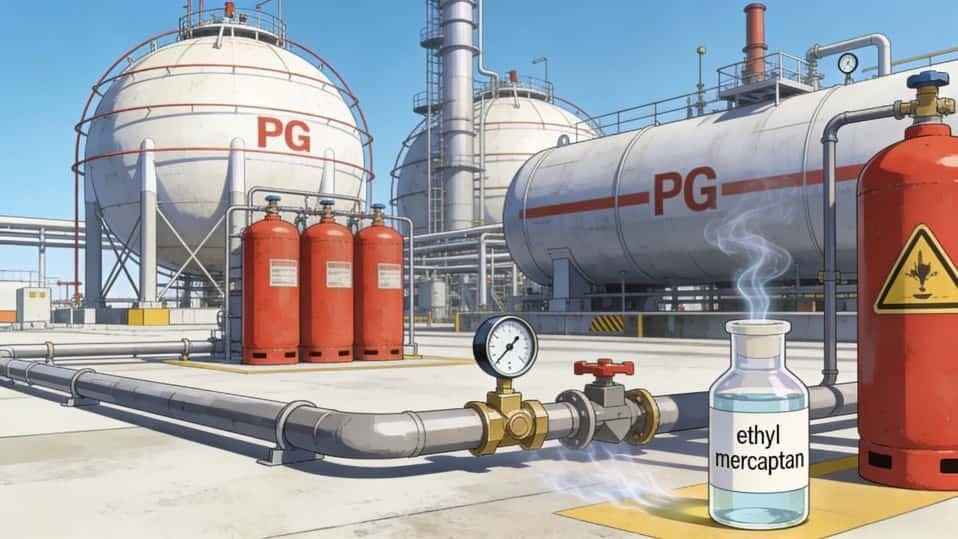
Understanding the Standard Dosage of Ethyl Mercaptan in Propane
The concentration of ethyl mercaptan (C₂H₅SH) in propane is not arbitrary—it is the result of decades of safety engineering, regulatory frameworks, and human sensory studies. The goal is to ensure that even a small leak produces a noticeable odor long before the gas concentration becomes dangerous.
Typical Industry Dosage Standards
| Parameter | Typical Value | Explanation |
|---|---|---|
| Odorant Type | Ethyl Mercaptan | Most common LPG odorant worldwide |
| Injection Rate | 1.0–1.5 lb / 10,000 gal propane | Standard North American practice |
| Gas Phase Concentration | ~16–24 mg/m³ | Detectable by human nose |
| Detection Threshold | ~0.5–1 ppm | Extremely low odor threshold |
| Target Detection Level | 1/5 LEL (~0.4% propane in air) | Safety margin requirement |
Why This Range?
- Human Sensitivity: Ethyl mercaptan has an extremely low odor detection threshold (~1 part per billion in some cases).
- Safety Margin: Regulations require detection at ≤20% of the Lower Explosive Limit (LEL).
- Consistency: The dosage ensures detectability across different temperatures, pressures, and storage conditions.
Regulatory Framework
Different countries have similar but slightly varying requirements:
| Region | Standard | Requirement |
|---|---|---|
| USA | NFPA 58 | Detectable at 1/5 LEL |
| EU | EN 589 | Odorized LPG mandatory |
| ISO | ISO 13734 | Odorization guidelines |
| China | GB 11174 | LPG odorization required |
Chemical and Physical Behavior of Ethyl Mercaptan in Propane
To understand dosage, you must also understand how ethyl mercaptan behaves once injected into propane.
Key Properties
| Property | Value | Impact |
|---|---|---|
| Molecular Formula | C₂H₅SH | Simple thiol |
| Boiling Point | 35°C | Easily vaporizes with propane |
| Odor | Strong sulfur smell | Detectable at ultra-low levels |
| Solubility | Miscible with LPG | Ensures uniform distribution |
Distribution in Propane Systems
Ethyl mercaptan dissolves into liquid propane and vaporizes along with it. However, several phenomena can affect its concentration:
- Adsorption: Steel tanks and pipelines can absorb odorant
- Oxidation: Over time, odorant may degrade
- Stripping: Repeated vaporization cycles reduce concentration
Odor Fade Phenomenon
One of the most critical technical challenges is odor fade, where the smell becomes less detectable even though gas is present.
Causes of Odor Fade
- Chemical oxidation
- Adsorption on tank walls
- Reaction with rust or scale
- Absorption into new steel cylinders
Engineering Countermeasures
- Slightly higher initial dosing
- Periodic re-odorization
- Tank conditioning procedures
- Use of stabilizers
Injection Systems and Process Control
The accuracy of ethyl mercaptan dosing depends heavily on the injection system design.
Types of Injection Systems
| System Type | Description | Application |
|---|---|---|
| Wick System | Passive evaporation | Small-scale LPG systems |
| Bypass Injection | Uses pressure differential | Medium facilities |
| Pump Injection | Precise metering pump | Large terminals |
| Electronic Injection | Automated control system | High-precision plants |
Key Control Parameters
- Flow rate of propane
- Temperature and pressure
- Odorant concentration
- Injection pump calibration
Example Calculation
For a propane storage facility handling 100,000 gallons:
- Required odorant = 10–15 lbs ethyl mercaptan
- Injection rate must adjust dynamically based on flow
Industrial Case Study: LPG Distribution Terminal
Consider a mid-sized LPG terminal:
- Storage capacity: 500,000 gallons
- Daily throughput: 50,000 gallons
Odorant Consumption Table
| Parameter | Value |
|---|---|
| Daily Propane Throughput | 50,000 gallons |
| Odorant Rate | 1.25 lb / 10,000 gal |
| Daily Odorant Use | ~6.25 lbs |
| Monthly Consumption | ~187.5 lbs |
Operational Challenges
- Maintaining consistent odor intensity
- Preventing overdosing
- Monitoring odor fade in storage tanks
Safety Implications and Risk Management
Ethyl mercaptan dosage directly impacts safety outcomes.
Too Low Dosage Risks
- Undetectable leaks
- Increased explosion risk
- Regulatory violations
Too High Dosage Risks
- Odor complaints
- Environmental concerns
- Equipment corrosion (long-term)
Safety Optimization Strategy
- Maintain within regulatory range
- Regular odor intensity testing
- Automated monitoring systems
Comparison: Ethyl Mercaptan vs Other Odorants
| Odorant | Odor Strength | Stability | Cost | Usage |
|---|---|---|---|---|
| Ethyl Mercaptan | Very high | Moderate | Low | Most common |
| Tertiary Butyl Mercaptan (TBM) | High | Higher | Medium | Natural gas |
| Dimethyl Sulfide | Moderate | High | Low | Limited use |
Ethyl mercaptan remains dominant due to its cost-effectiveness and strong odor profile.
Engineering Guidelines for Optimal Dosing
Key Design Considerations
- Storage tank material
- Pipeline length
- Environmental conditions
- Turnover rate of propane
Recommended Practices
- Use calibrated injection pumps
- Perform periodic odor checks
- Maintain documentation for compliance
Advanced Monitoring Technologies
- Gas chromatography for odorant concentration
- Electronic noses (e-nose systems)
- IoT-based injection control systems
Practical Guidelines for Buyers and Operators
When sourcing ethyl mercaptan or designing an odorization system:
What to Look For
- High purity (>99%)
- Stable supply chain
- Compliance with safety standards
- Reliable technical support
Procurement Checklist
| Item | Requirement |
|---|---|
| Purity | ≥99% |
| Packaging | Drum / ISO tank |
| Certification | SDS, COA |
| Supplier Capability | Consistent supply |
Conclusion: Precision Matters in Propane Odorization
The amount of ethyl mercaptan added to propane is a carefully engineered parameter—not a rough estimate. The standard range of 1.0–1.5 lb per 10,000 gallons ensures that propane remains safe, detectable, and compliant with global regulations. Too little compromises safety; too much introduces operational and environmental issues. The key lies in precise dosing, reliable systems, and continuous monitoring.
Need Reliable Ethyl Mercaptan Supply? Let’s Talk
If you’re sourcing high-purity ethyl mercaptan or designing a propane odorization system, getting the dosage and supply right is critical. At Sparrow Chemicals, we support global LPG operators with consistent quality, stable supply, and practical technical guidance tailored to real-world applications.
👉 Visit us: https://sparrow-chemical.com/
Let’s make your propane systems safer, more reliable, and fully compliant.