Skip to content
Featured image placeholder (for blog header use)
AI Image Prompt: Effect of CF₃ groups on hexafluoroacetone reactivity, scientific chemistry illustration, strong electron-withdrawing CF₃ substituents highlighted, carbonyl carbon shown as reactive center, fluorine chemistry laboratory background, precise and analytical atmosphere, soft neutral lighting
Hexafluoroacetone is not reactive by accident. Its behavior is the direct consequence of deliberate molecular design, and at the center of that design are two trifluoromethyl (CF₃) groups. For chemists and process engineers, misunderstanding how CF₃ groups influence reactivity leads to poor reaction control, unexpected side reactions, and avoidable safety risks. Conversely, understanding their role explains why hexafluoroacetone is such a powerful—and irreplaceable—fluorochemical intermediate.
CF₃ groups dramatically increase hexafluoroacetone reactivity by exerting extreme electron-withdrawing inductive effects, suppressing electron donation, intensifying carbonyl polarization, and stabilizing reaction transition states, collectively making the carbonyl carbon exceptionally electrophilic.
CF₃ groups as extreme electron-withdrawing substituents
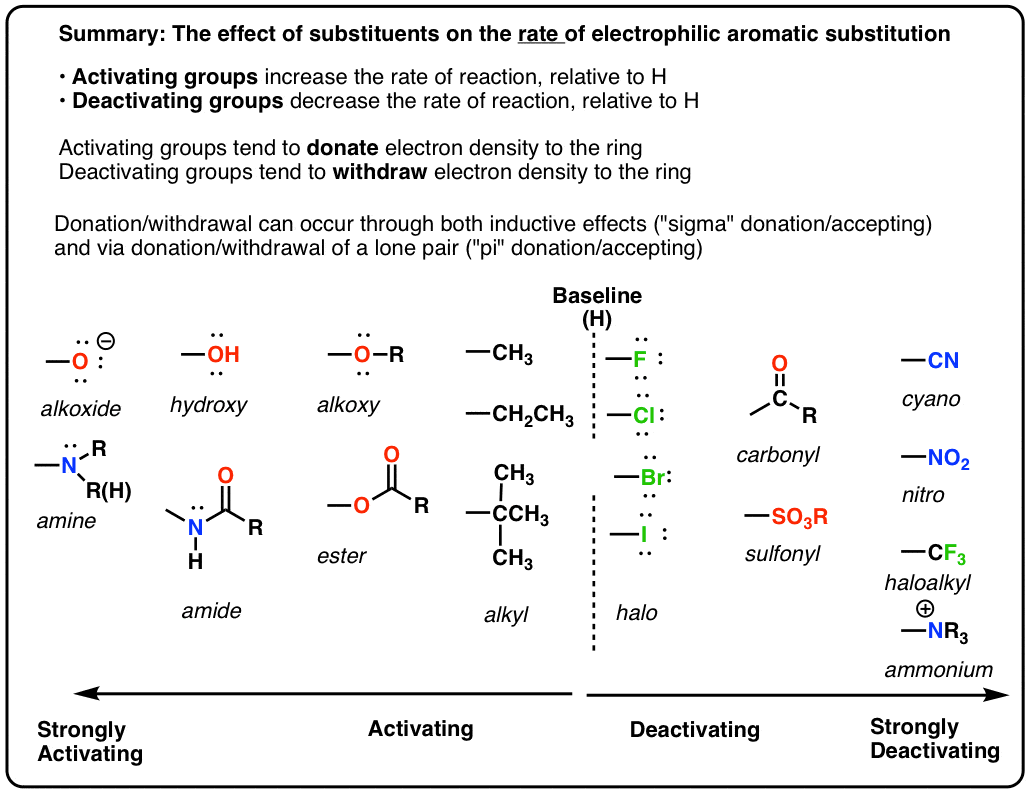
The trifluoromethyl group is one of the strongest electron-withdrawing substituents available in organic chemistry. Each CF₃ group contains three fluorine atoms, and fluorine’s exceptionally high electronegativity pulls electron density away from the carbon framework through a strong inductive (−I) effect.
In hexafluoroacetone, two CF₃ groups are positioned directly adjacent to a carbonyl group. Their electron-withdrawing effects reinforce each other, stripping electron density from the carbonyl carbon more aggressively than almost any other substituent combination found in ketones. This creates an electron-poor reaction center that strongly attracts nucleophiles.
Suppression of electron donation and resonance stabilization
In conventional ketones, alkyl groups such as methyl groups donate electron density via hyperconjugation, stabilizing the carbonyl and moderating its reactivity. CF₃ groups do the opposite. They are incapable of meaningful electron donation because the carbon–fluorine bond is short, strong, and poorly polarizable.
As a result:
- No stabilizing hyperconjugation occurs
- No effective π-donation into the carbonyl system is possible
- The carbonyl remains electronically “unsatisfied”
This lack of compensation amplifies the intrinsic electrophilicity created by inductive withdrawal.
Intensified polarization of the carbonyl bond
The combined CF₃ inductive effects strongly polarize the carbonyl bond. Electron density is pushed toward the oxygen atom, while the carbonyl carbon becomes highly positive in character. This polarization lowers the energy of the lowest unoccupied molecular orbital (LUMO), making nucleophilic attack both kinetically faster and thermodynamically more favorable.
In practical terms, this means that reactions involving hexafluoroacetone often proceed:
- At lower temperatures
- With weaker nucleophiles
- At higher rates than expected
This behavior distinguishes hexafluoroacetone from ordinary or even moderately fluorinated ketones.

Minimal steric shielding despite bulky groups
Although CF₃ groups are sterically bulky, they do not effectively shield the carbonyl carbon. Their geometry leaves the electrophilic center relatively accessible, especially along the Bürgi–Dunitz trajectory favored for nucleophilic addition to carbonyls.
This unusual combination—high steric bulk without steric protection—means that electronic effects dominate reactivity. CF₃ groups amplify reactivity without blocking access to the reactive site.
Stabilization of reaction transition states
CF₃ groups also stabilize negative charge development in reaction transition states and intermediates. During nucleophilic addition, partial negative charge builds up on oxygen and adjacent atoms. The electron-withdrawing nature of CF₃ groups helps delocalize and stabilize this charge, lowering activation energy and accelerating reaction rates.
This effect is especially important in cycloaddition, condensation, and addition reactions commonly used in fluorochemical synthesis.
Comparative impact of CF₃ substitution
The effect of CF₃ groups becomes clearer when comparing related ketones:
| Ketone | Substituents | Relative reactivity |
|---|---|---|
| Acetone | CH₃ / CH₃ | Low |
| Trifluoroacetone | CF₃ / CH₃ | High |
| Hexafluoroacetone | CF₃ / CF₃ | Extreme |
Replacing even one CF₃ group with a less electron-withdrawing substituent significantly reduces reactivity. This demonstrates that the dual CF₃ configuration is essential to hexafluoroacetone’s behavior.
Consequences for industrial chemistry
Because CF₃ groups drive such strong reactivity, hexafluoroacetone must be handled as a designed electrophile, not a passive reagent. Its CF₃-induced behavior enables:
- Shorter synthesis routes
- Efficient fluorine incorporation
- Unique fluorinated architectures
At the same time, it requires:
- Strict moisture and impurity control
- Controlled addition and temperature management
- Specialized containment and trained personnel
Industrial success depends on embracing the CF₃-driven reactivity rather than attempting to suppress it.
Why CF₃ effects are difficult to replicate
Other electron-withdrawing groups rarely match the strength, compactness, and chemical stability of CF₃. Substitutes often introduce instability, steric blockage, or regulatory complications. This is why hexafluoroacetone remains uniquely valuable despite its demanding handling requirements.
Final summary
CF₃ groups are the defining factor behind hexafluoroacetone’s extraordinary reactivity. Through powerful electron-withdrawing inductive effects, suppression of electron donation, intense carbonyl polarization, and transition-state stabilization, two CF₃ groups transform an ordinary ketone framework into one of the most electrophilic carbonyl compounds used in industrial chemistry.
Understanding this CF₃-driven behavior is essential for safe handling, effective synthesis design, and successful application of hexafluoroacetone.
A practical note from industry experience
In real-world fluorochemical projects, the most reliable processes are those that treat CF₃ effects as a predictable design parameter. When reactions are built around this electronic reality, hexafluoroacetone delivers exceptional performance with high efficiency and control.
Talk to Sparrow-Chemical about fluorochemical intermediates
If you are sourcing hexafluoroacetone or designing reactions that rely on CF₃-driven reactivity, Sparrow-Chemical provides application-focused technical guidance and dependable global supply. We help customers harness fluorine chemistry precisely and responsibly. Visit https://sparrow-chemical.com/ to discuss your requirements with our technical team.