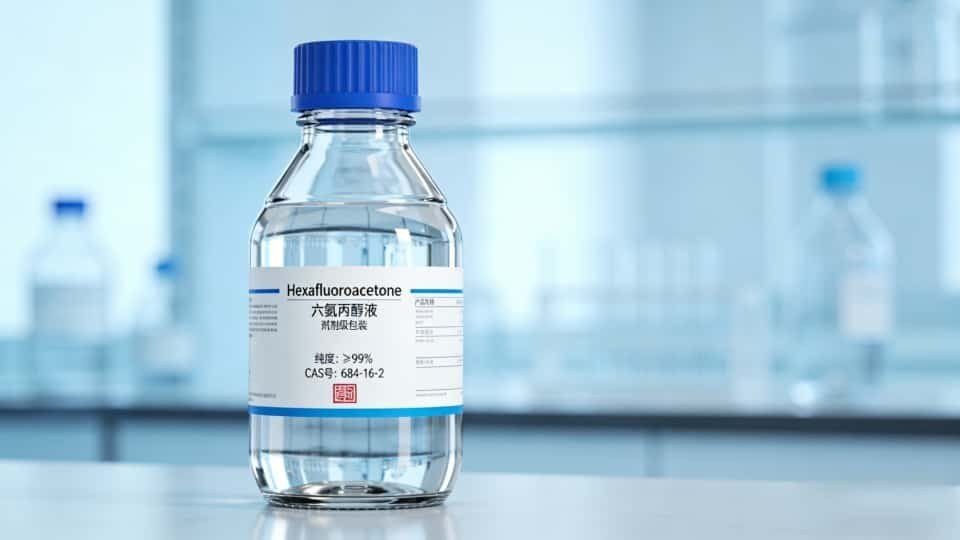
In the fluorochemical industry, only a small number of intermediates act as structural bridges between raw fluorine chemistry and high-value specialty products. Hexafluoroacetone (HFA) is one of these strategic bridges. While its production volume is modest compared to commodity fluorinated monomers, its structural characteristics allow the controlled introduction of trifluoromethyl (CF₃) functionality into advanced molecular systems. Without such intermediates, the synthesis of specialty fluorochemicals would require multi-step fluorination routes, lower selectivity processes, or significantly higher costs. The consequence of underestimating HFA’s role is missing its central position in enabling high-performance, high-margin fluorinated materials.
Hexafluoroacetone supports specialty fluorochemicals by functioning as a highly reactive, CF₃-rich carbonyl intermediate that enables efficient synthesis of fluorinated alcohols, diols, comonomers, heterocycles, surface modifiers, electronic-grade materials, and advanced polymer modifiers. Its strong electron-withdrawing CF₃ groups provide thermal stability, chemical resistance, low surface energy, and tunable polarity—properties that define specialty fluorochemical performance.
To understand its strategic support role, we must analyze structural chemistry, reactivity pathways, derivative families, performance mechanisms, industrial integration, and economic impact.
1. Structural Foundation: Why HFA Is a Powerful Building Block
Hexafluoroacetone has the structure:
(CF₃)₂CO
This configuration delivers three essential characteristics:
• Two highly electron-withdrawing CF₃ groups
• A strongly polarized carbonyl center
• No alpha-hydrogen reactivity
The CF₃ groups provide:
• Strong C–F bonds (~485 kJ/mol)
• Low polarizability
• Steric bulk
• Exceptional thermal stability
Structural Influence Overview
| Structural Element | Functional Effect |
|---|---|
| CF₃ substitution | Chemical resistance |
| Carbonyl activation | Reactivity toward nucleophiles |
| Fluorine density | Low surface energy |
This combination enables selective synthesis of fluorinated specialty compounds.
2. Gateway to Fluorinated Alcohol Systems
One of the primary specialty fluorochemicals derived from HFA is hexafluoroisopropanol (HFIP).
Reaction concept:
(CF₃)₂CO → (CF₃)₂CHOH
HFIP supports specialty markets such as:
• Pharmaceutical synthesis
• Advanced polymer processing
• Electronic-grade solvent systems
Why HFIP Matters
| Property | Specialty Advantage |
|---|---|
| High polarity | Dissolves fluoropolymers |
| Hydrogen bonding strength | Unique solvation properties |
| Chemical stability | High-performance processing |
Without HFA, industrial-scale production of HFIP would be inefficient and economically unattractive.
3. Enabling Specialty Fluoropolymer Modification
Specialty fluoropolymers require fine-tuned performance beyond PTFE or PVDF.
HFA-derived intermediates introduce CF₃ functionality into:
• Comonomers
• Polymer side chains
• Reactive modifiers
Property Enhancement Matrix
| Performance Parameter | Impact of CF₃ Incorporation |
|---|---|
| Chemical resistance | Increased |
| Thermal stability | Maintained or improved |
| Melt processability | Improved |
| Surface energy | Reduced |
| Dielectric constant | Lowered |
These modifications support:
• Semiconductor tubing
• Aerospace coatings
• Plasma-resistant materials
4. Specialty Heterocycles and Advanced Intermediates
HFA reacts with nucleophiles such as:
• Amines
• Hydrazines
• Alcohols
Producing:
• CF₃-substituted heterocycles
• Fluorinated pharmaceutical intermediates
• Agrochemical building blocks
CF₃ groups improve:
• Metabolic stability
• Lipophilicity tuning
• Environmental resistance
Pharmaceutical & Agrochemical Impact
| Feature | Benefit |
|---|---|
| CF₃ group | Increased bioavailability |
| Electron-withdrawing nature | Modulates reactivity |
| Stability | Longer functional lifetime |
These properties make HFA central in specialty molecule design.
5. Surface Energy Engineering in Specialty Materials
Fluorochemicals often aim to reduce surface energy for:
• Anti-fouling coatings
• Release agents
• Water-repellent systems
CF₃ groups are among the lowest surface-energy substituents available.
Surface Energy Comparison
| Material | Surface Energy (mN/m) |
|---|---|
| Polyethylene | ~31 |
| PTFE | ~18 |
| CF₃-modified systems | Potentially lower |
HFA-derived materials support high-performance non-stick technologies.
6. Electronic and Semiconductor Specialty Chemicals
Semiconductor fabrication requires materials that:
• Resist aggressive etching gases
• Maintain structural integrity under plasma exposure
• Avoid contamination
HFA-derived fluorinated components are used in:
• Low-k dielectric materials
• Plasma-resistant polymers
• Advanced cleaning formulations
Electronic Performance Parameters
| Requirement | Contribution of HFA |
|---|---|
| Chemical inertness | Strong C–F bonding |
| Low dielectric constant | CF₃ effect |
| Thermal endurance | Fluorine stability |
These attributes enable microelectronics reliability.
7. Process Chemistry Advantages
Alternative methods of introducing CF₃ groups into molecules can involve:
• Direct fluorination (hazardous)
• Multi-step synthesis
• Expensive reagents
HFA offers:
• Pre-installed CF₃ framework
• Selective carbonyl reactivity
• Efficient one-step functionalization routes
This reduces synthetic complexity and improves yield consistency.
8. Integration into Specialty Fluorochemical Value Chain
The fluorochemical value chain progresses as:
Fluorspar → Hydrogen fluoride → Fluorinated intermediates → Hexafluoroacetone → Specialty derivatives → Advanced materials
HFA acts as a transformation node between basic fluorine chemistry and high-value applications.
9. Economic Contribution to Specialty Markets
Although HFA production volume is smaller than bulk fluorochemicals, its derivatives support:
• High-margin sectors
• Aerospace materials
• Advanced electronics
• Pharmaceutical synthesis
Value Perspective
| Category | Commodity Fluorochemical | HFA-Derived Specialty |
|---|---|---|
| Volume | High | Moderate |
| Margin | Moderate | High |
| Technical complexity | Lower | Higher |
Its economic importance is disproportionate to its tonnage.
10. Performance Stability Under Extreme Conditions
CF₃ substitution ensures:
• Resistance to UV degradation
• Resistance to oxidation
• Stability in corrosive environments
These qualities are essential for:
• Chemical processing equipment
• Oil and gas components
• Aerospace systems
11. Engineering Implications
Material scientists value HFA-derived structures for:
• Tailored glass transition temperatures
• Controlled crystallinity
• Optimized flexibility
By adjusting CF₃ content, specialty fluorochemicals can be engineered precisely for performance targets.
12. Strategic Supply Significance
Because HFA supports high-performance specialty products, supply reliability is critical. Disruptions in HFA availability can affect:
• Fluoropolymer manufacturing
• Pharmaceutical intermediate production
• Semiconductor material supply chains
Thus, it holds strategic industrial importance.
Final Technical Conclusion
Hexafluoroacetone supports specialty fluorochemicals by serving as a highly reactive CF₃-rich intermediate that enables efficient synthesis of fluorinated alcohols, diols, heterocycles, polymer modifiers, surface-engineering agents, and electronic-grade materials. Its dual trifluoromethyl substitution provides exceptional thermal stability, chemical resistance, low surface energy, and tunable polarity—properties that define high-performance fluorinated specialty products. By bridging basic fluorine chemistry and advanced material systems, HFA occupies a central structural and economic role in the specialty fluorochemical value chain.
Partner with a Reliable Source for Hexafluoroacetone
At Sparrow-Chemical, we supply high-purity hexafluoroacetone designed to support advanced specialty fluorochemical synthesis, fluoropolymer modification, and electronic-grade applications. Our production systems emphasize moisture control, strict analytical validation, and stable global logistics.
Visit:
https://sparrow-chemical.com/
If your specialty fluorochemical project depends on consistent CF₃-functional intermediates, our technical team is ready to support your development and sourcing strategy.