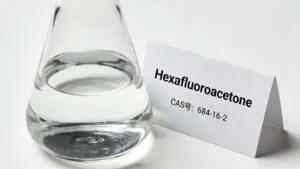

Manufacturing hexafluoroacetone (HFA) is not a simple oxidation or solvent conversion process—it is a high-precision fluorochemical transformation that involves hazardous fluorinating agents, chlorinated intermediates, controlled thermal conditions, and advanced corrosion-resistant equipment. Many buyers assume that hexafluoroacetone is derived directly from acetone via fluorination, but this is chemically inaccurate. Improper understanding of feedstocks leads to procurement errors, unrealistic cost expectations, and misjudged safety requirements. The production of HFA requires carefully selected halogenated raw materials, anhydrous hydrogen fluoride systems, and high-purity purification stages.
The primary raw materials used to manufacture hexafluoroacetone are chlorinated C₂ or C₃ hydrocarbons (such as perchloroethylene or hexachloroacetone), anhydrous hydrogen fluoride (HF) as the fluorinating agent, and auxiliary materials including catalysts, stabilizers, and corrosion-resistant process systems. In industrial practice, the most common pathway involves fluorination of chlorinated precursors followed by high-temperature halogen exchange and purification via distillation under strictly controlled moisture-free conditions.
Understanding these raw materials requires analyzing the chemical reaction mechanisms, halogen exchange chemistry, process engineering constraints, and industrial-scale feasibility.
Fundamental Chemical Basis of Hexafluoroacetone Production
Hexafluoroacetone has the molecular formula (CF₃)₂CO. To produce it efficiently at scale, manufacturers must:
• Replace hydrogen atoms with fluorine
• Introduce two CF₃ groups symmetrically
• Maintain carbonyl functionality
• Prevent side reactions such as over-oxidation
Direct fluorination of hydrocarbons is typically uncontrolled and leads to decomposition. Therefore, controlled halogen exchange using chlorinated intermediates is the dominant strategy.
Primary Raw Material Categories
1. Chlorinated Hydrocarbon Precursors
The most common carbon skeleton sources include:
• Perchloroethylene (C₂Cl₄)
• Hexachloroacetone (C₃Cl₆O)
• Chlorinated propanone derivatives
These materials provide a halogen-rich backbone that can undergo fluorine substitution via halogen exchange reactions.
| Precursor | Role in Process | Advantages |
|---|---|---|
| Perchloroethylene | Carbon source | High halogen density |
| Hexachloroacetone | Direct structural similarity | Easier CF₃ transformation |
| Chlorinated ketones | Controlled intermediate | Reaction selectivity |
Chlorinated precursors are preferred because chlorine-to-fluorine exchange is more controllable than hydrogen-to-fluorine direct substitution.
2. Anhydrous Hydrogen Fluoride (HF)
Hydrogen fluoride is the principal fluorinating agent.
Functions:
• Provides fluorine atoms
• Enables halogen exchange (Cl → F)
• Acts as solvent and reactant
Industrial HF must be:
• Water-free (moisture leads to corrosion and side reactions)
• High purity
• Stored in corrosion-resistant systems (Monel, Hastelloy, PTFE-lined vessels)
| Property | Industrial HF |
|---|---|
| Purity | ≥99.9% |
| Moisture content | <0.05% |
| Boiling point | 19.5°C |
| Corrosiveness | Extremely high |
HF is not merely a reagent—it defines the entire plant design philosophy.
3. Catalysts and Reaction Promoters
Fluorination reactions require catalytic control.
Typical catalytic systems:
• Antimony pentachloride (SbCl₅)
• Chromium-based catalysts
• Aluminum fluoride derivatives
Catalysts enhance halogen exchange efficiency and minimize by-product formation.
4. Auxiliary Raw Materials
Additional materials involved:
• Nitrogen (inert atmosphere control)
• Cooling media (thermal control)
• Corrosion inhibitors
• Drying agents (molecular sieves)
These are essential to maintain reaction selectivity and product purity.
Industrial Production Pathway Overview
The typical industrial route involves:
Chlorinated precursor + HF → Fluorinated intermediate → Hexafluoroacetone → Distillation purification
Representative Reaction Concept
C₃Cl₆O + 6 HF → C₃F₆O + 6 HCl
The reaction generates hydrogen chloride (HCl) as a by-product, which must be:
• Neutralized
• Recovered
• Scrubbed via alkaline systems
Process Engineering Considerations
Reactor Materials
Due to extreme corrosiveness:
• Nickel alloys
• Monel
• PTFE linings
• Graphite heat exchangers
are used in plant construction.
Moisture Control
Even trace water causes:
• HF dilution
• Hydrolysis
• Equipment corrosion
Industrial production requires near-anhydrous systems.
Comparative Feedstock Economics
| Raw Material | Availability | Cost Impact | Strategic Importance |
|---|---|---|---|
| Perchloroethylene | Widely available | Moderate | Key carbon source |
| Hexachloroacetone | Specialized | Higher | Direct precursor |
| HF | Produced via fluorspar | High | Critical reagent |
Hydrogen fluoride production itself depends on:
Fluorspar (CaF₂) + H₂SO₄ → HF + CaSO₄
Thus, upstream mining of fluorspar is indirectly part of the HFA supply chain.
Fluorspar as the Upstream Origin
Fluorspar (calcium fluoride) is mined and reacted with sulfuric acid to produce HF.
| Material | Role |
|---|---|
| Fluorspar | Fluorine source |
| Sulfuric acid | HF liberation agent |
| CaSO₄ | By-product |
Without fluorspar mining, fluorochemical manufacturing is impossible.
Purification Stage Raw Materials
Post-reaction purification requires:
• Distillation columns
• Drying agents
• Fractional separation systems
Impurities removed:
• Residual HF
• HCl
• Chlorinated intermediates
• Oligomeric by-products
High-purity HFA (>99.5%) is required for fluoropolymer synthesis.
By-Products and Waste Management Inputs
• Caustic soda for HCl neutralization
• Activated carbon for gas scrubbing
• Wastewater treatment chemicals
Environmental compliance requires additional raw materials beyond core feedstocks.
Supply Chain Complexity
Hexafluoroacetone production depends on:
- Fluorspar mining
- Sulfuric acid production
- Chlorinated hydrocarbon manufacturing
- HF production
- Fluorination reaction infrastructure
Each stage affects final cost and availability.
Safety-Critical Raw Materials
HF and chlorinated intermediates are toxic and corrosive. Industrial production requires:
• Closed-loop systems
• Acid-resistant pumps
• Leak detection sensors
• Scrubbing towers
Raw Material Integration Summary Table
| Category | Material | Function |
|---|---|---|
| Carbon source | Perchloroethylene / Hexachloroacetone | Provides carbon backbone |
| Fluorinating agent | Anhydrous HF | Introduces fluorine atoms |
| Catalyst | SbCl₅ or similar | Reaction acceleration |
| Inert gas | Nitrogen | Atmosphere control |
| Upstream mineral | Fluorspar | Fluorine origin |
| Acid feed | Sulfuric acid | HF production |
| Neutralizing agent | NaOH | HCl scrubbing |
Strategic Importance of Raw Material Selection
Selecting appropriate chlorinated precursor determines:
• Reaction yield
• Selectivity
• Impurity profile
• Production cost
Hydrogen fluoride purity determines:
• Equipment lifespan
• Product quality
• Safety compliance
Why Raw Materials Define Product Quality
Impure HF leads to:
• Polymer contamination
• Side-product formation
• Reduced fluoropolymer performance
High-purity feedstocks ensure:
• Stable downstream polymerization
• Electronic-grade material compatibility
• Regulatory compliance
Industrial Insight
In advanced fluoropolymer production (e.g., FEP, PFA), trace contamination from raw materials can cause catastrophic polymer defects. Therefore, raw material traceability is critical.
Final Technical Summary
Hexafluoroacetone production depends on:
• Chlorinated hydrocarbon precursors
• Anhydrous hydrogen fluoride
• Catalytic halogen exchange systems
• Fluorspar-derived upstream fluorine
• Strict moisture-free, corrosion-resistant infrastructure
It is a highly specialized fluorochemical manufacturing process, not a simple solvent modification.
Conclusion
The raw materials used to produce hexafluoroacetone originate from a sophisticated fluorochemical supply chain that begins with fluorspar mining and extends through hydrogen fluoride production, chlorinated intermediate preparation, catalytic halogen exchange, and high-purity distillation. The choice and quality of each raw material directly influence yield, purity, safety, and downstream fluoropolymer performance.
Let’s Discuss Reliable Hexafluoroacetone Supply
At Sparrow-Chemical, we understand that fluorochemical manufacturing begins with raw material precision. We supply high-purity hexafluoroacetone produced through controlled halogen exchange processes using certified upstream fluorine sources and strict moisture-controlled systems.
If your polymer, agrochemical, or specialty material project depends on reliable HFA quality, visit:
Our team is ready to support your sourcing requirements with technical documentation, compliance data, and stable global delivery.