Skip to content

In fluorochemical discussions, hexafluoroacetone is frequently mentioned, but its basic chemical identity is often taken for granted. For chemists, engineers, procurement teams, and regulatory reviewers, misunderstanding the molecular formula can lead to confusion about reactivity, classification, safety, and downstream application. A clear explanation of the chemical formula is therefore not academic detail—it is the foundation for understanding how this compound behaves and why it is used.
The chemical formula of hexafluoroacetone is C₃F₆O.
This concise formula captures the defining feature of the compound: a fully fluorinated acetone structure in which all hydrogen atoms have been replaced by fluorine.
How the chemical formula C₃F₆O is derived
To understand the formula of hexafluoroacetone, it is useful to begin with acetone, one of the simplest and most familiar ketones. Acetone has the molecular formula C₃H₆O. Its structure consists of a central carbonyl group (C=O) flanked by two methyl groups (CH₃).
In hexafluoroacetone, every hydrogen atom in those two methyl groups is replaced by fluorine. Each CH₃ group becomes a CF₃ group. This substitution does not change the number of carbon or oxygen atoms, but it completely transforms the chemical behavior of the molecule.
The transformation can be summarized as follows:
- Carbon atoms remain unchanged: 3
- Oxygen atoms remain unchanged: 1
- Hydrogen atoms (6 total) are replaced by fluorine atoms
The resulting molecular formula is therefore C₃F₆O.
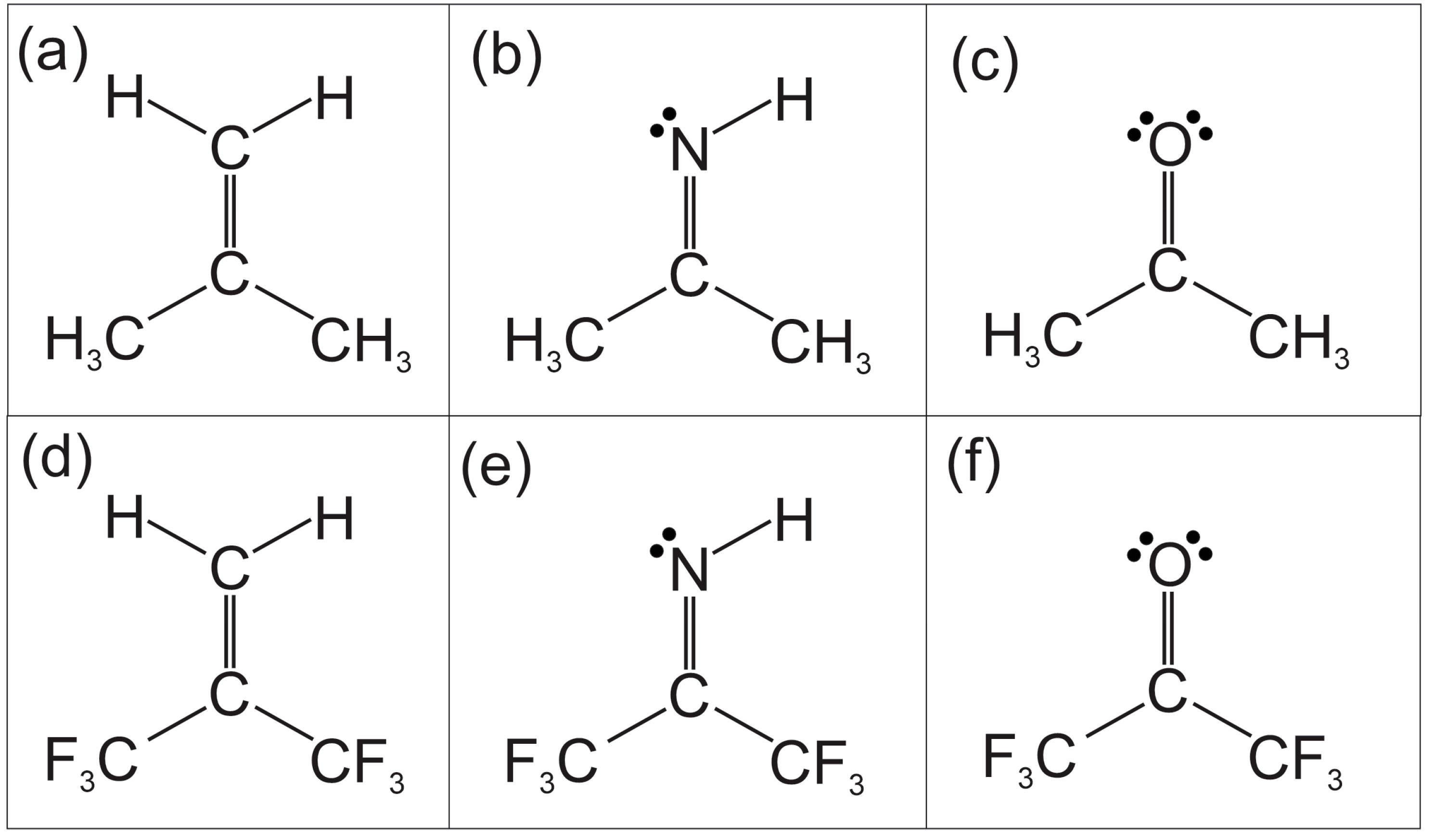
Structural representation and common notation
While the empirical formula is C₃F₆O, hexafluoroacetone is often written in a more descriptive structural form as:
(CF₃)₂CO
This notation highlights two important aspects. First, it makes clear that the molecule contains two trifluoromethyl (CF₃) groups. Second, it emphasizes the presence of a carbonyl functional group, confirming that hexafluoroacetone is a ketone.
From a practical standpoint, this structural representation is often more useful than the simple molecular formula, because it immediately signals the compound’s high fluorine content and strong electron-withdrawing character.
Why the formula matters in fluorochemistry
The formula C₃F₆O is not just a bookkeeping exercise. It explains much of hexafluoroacetone’s unusual chemistry. Fluorine is the most electronegative element, and six fluorine atoms exert a powerful electron-withdrawing effect on the carbonyl carbon. This makes the molecule far more reactive than acetone toward nucleophiles.
As a result, hexafluoroacetone behaves very differently from conventional ketones. It is not used as a solvent or general-purpose reagent. Instead, it functions as a highly reactive fluorinated building block in advanced synthesis.
Understanding the formula also clarifies why the compound is volatile, chemically aggressive, and unsuitable for casual handling. These properties are direct consequences of its fluorine-rich structure.
Relationship between formula and industrial use
Because hexafluoroacetone contains six fluorine atoms in a compact structure, it serves as an efficient way to introduce fluorinated functionality into larger molecules. This is why it is widely used as an intermediate in:
- Fluoropolymer monomer synthesis
- Specialty fluorochemical intermediates
- Pharmaceutical and agrochemical research
- Advanced materials chemistry
In all these cases, the compound is consumed during synthesis rather than appearing in finished products. The molecular formula helps regulatory and safety professionals immediately recognize it as a reactive intermediate, not a consumer-facing substance.
Comparing hexafluoroacetone with acetone highlights the impact of fluorination:
| Compound | Molecular formula | Key behavior |
|---|---|---|
| Acetone | C₃H₆O | Mild, stable solvent |
| Hexafluoroacetone | C₃F₆O | Highly reactive intermediate |
Despite having the same carbon and oxygen framework, the replacement of hydrogen with fluorine completely alters chemical performance.
Final summary
The chemical formula of hexafluoroacetone is C₃F₆O, commonly expressed structurally as (CF₃)₂CO. This formula reflects a fully fluorinated ketone whose properties are dominated by strong electron-withdrawing fluorine atoms. Understanding this formula is essential for grasping why hexafluoroacetone is so reactive, why it is used primarily as an intermediate, and why it requires careful handling in industrial environments.
A practical note from industry experience
In real fluorochemical projects, simply recognizing the formula C₃F₆O immediately signals that hexafluoroacetone belongs to a different risk and performance category than ordinary ketones. Teams that appreciate this distinction make better decisions in synthesis design, sourcing, and safety management.
Talk to Sparrow-Chemical about fluorochemical intermediates
If you are sourcing hexafluoroacetone or evaluating fluorinated intermediates for polymer, pharmaceutical, or specialty chemical applications, Sparrow-Chemical provides application-focused technical guidance and reliable global supply. Visit https://sparrow-chemical.com/ to discuss your requirements with our technical team.