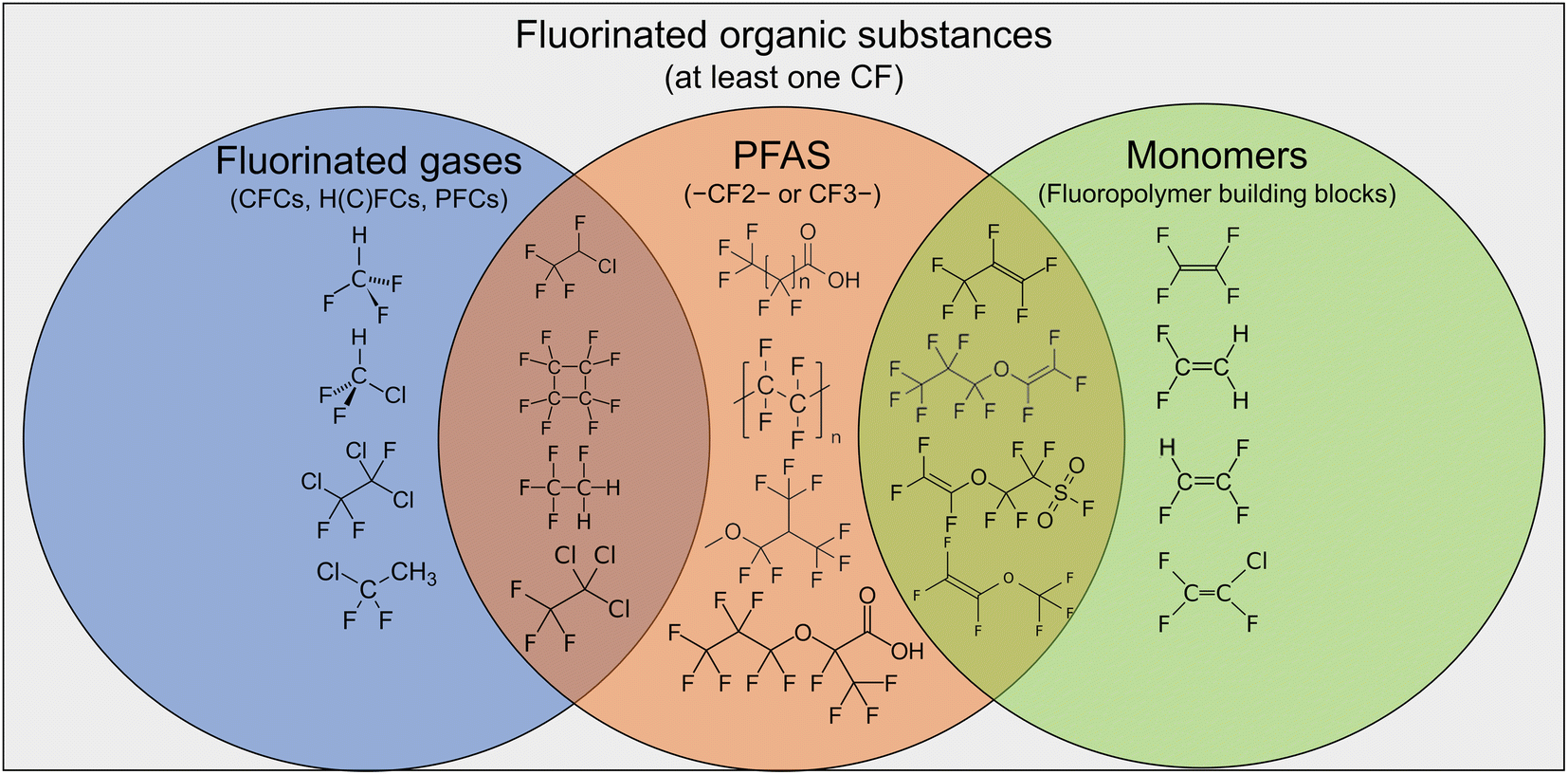
Selecting the wrong fluoro chemical is rarely an obvious mistake at the beginning—but it almost always becomes expensive later. Premature material failure, regulatory non-compliance, unexpected toxicity reviews, unstable formulations, or performance drift under real operating conditions are common consequences of poor selection. These failures are not caused by “bad chemistry,” but by misalignment between application requirements and fluorochemical behavior. The solution is a structured, engineering-driven selection methodology rather than brand-based or habit-based choice.
Selecting the right fluoro chemical requires defining the application duty window, matching it to the correct fluorochemical family, evaluating performance–risk–compliance tradeoffs, and validating the choice under real operating conditions. There is no universally “best” fluoro chemical—only the best fit for a specific application.
This guide outlines a practical, professional framework used by experienced formulators, engineers, and procurement teams to make fluorochemical selection decisions with confidence.
Effective fluorochemical selection depends on application conditions rather than chemical category alone.True
Fluorochemicals with similar names can exhibit radically different performance, stability, and regulatory profiles depending on temperature, media, stress, and exposure conditions.
Start with the application duty window, not the product name
The most common mistake in fluorochemical selection is starting with a product category—such as fluoropolymer, fluorinated solvent, or fluorosurfactant—before fully defining the operating environment. In professional practice, selection always begins with the duty window, a precise description of how and where the chemical must perform.
A complete duty window includes continuous and peak temperature, pressure or vacuum, contact media (acids, bases, solvents, fuels, water), exposure mode (immersion, vapor, splash, thin film), mechanical stress, electrical requirements, and cleanliness targets such as residue or outgassing limits. Without this definition, even a technically “advanced” fluoro chemical can fail.
Match the duty window to the correct fluorochemical family
Once the duty window is defined, the next step is to identify which fluorochemical family is structurally suited to that environment. Fluoro chemicals are not interchangeable; each family is optimized for different performance priorities.
Core fluorochemical families and their roles
| Fluoro chemical family | Primary strength | Typical use case |
|---|---|---|
| Fluoropolymers | Chemical & thermal resistance | Seals, linings, coatings |
| Fluorinated solvents | Volatility & cleanliness | Precision cleaning |
| Fluorosurfactants | Interfacial control | Coatings, emulsions |
| Fluorinated gases | Reactivity or insulation | Semiconductors, HVAC |
| Fluorinated intermediates | Functional synthesis | Pharma, agrochemicals |
Attempting to force a chemical outside its structural role often results in hidden performance or compliance problems.
Evaluate performance priorities and tradeoffs
Fluoro chemicals are chosen because they deliver extreme performance—but no fluorochemical maximizes every property simultaneously. Selection therefore involves tradeoff analysis.
Key performance questions include:
- Is chemical resistance or thermal stability the top priority?
- Is low surface energy more important than mechanical strength?
- Is rapid evaporation required, or long-term persistence?
- Is electrical insulation or dielectric stability critical?
- Is low friction or controlled adhesion required?
For example, highly fluorinated materials offer superior chemical inertness but may have higher cost or stricter regulatory oversight. Less fluorinated options may perform adequately at lower cost and risk.
Example performance comparison
| Property | Highly fluorinated | Partially fluorinated |
|---|---|---|
| Chemical resistance | Excellent | Good |
| Cost | Higher | Lower |
| Processability | More difficult | Easier |
| Regulatory scrutiny | Higher | Moderate |
Consider regulatory and compliance constraints early
Regulatory pressure—especially around PFAS—has fundamentally changed fluorochemical selection. Compliance is no longer a downstream issue; it is a front-end design constraint.
Professional selection includes early screening for:
- Regional regulatory status (EU, US, Asia)
- REACH and RoHS applicability
- PFAS classification and reporting obligations
- End-user or brand-specific restrictions
- Waste handling and disposal requirements
Choosing a technically excellent fluorochemical that later triggers regulatory rejection is one of the costliest mistakes a buyer can make.
Assess formulation and system compatibility
A fluoro chemical does not operate in isolation. Its compatibility with other formulation components—polymers, solvents, fillers, salts, enzymes, or additives—often determines success or failure.
Key compatibility checks include:
- Solubility or dispersibility
- Interaction with ionic species
- Stability under shear and temperature cycling
- Effect on viscosity and phase behavior
- Long-term storage stability
This is particularly critical for fluorosurfactants and fluorinated additives, where minor changes in structure can dramatically affect system behavior.
Balance performance against total cost of ownership
Selecting the right fluoro chemical is not about minimizing unit price. It is about minimizing total cost of ownership across the product lifecycle.
A higher-cost fluorochemical may:
- Extend service life
- Reduce maintenance frequency
- Enable thinner coatings or lower dosages
- Improve yield or reduce scrap
- Simplify compliance management
Experienced buyers evaluate cost in terms of system-level impact, not invoice price.
Validate through testing, not assumptions
No fluorochemical selection is complete without validation under real or simulated operating conditions. Laboratory screening is only the first step. Pilot-scale or field testing often reveals issues that datasheets cannot predict.
Validation should cover:
- Performance consistency
- Degradation pathways
- Interaction with contaminants
- Aging and cycling effects
- Failure modes
Skipping this step often results in delayed but expensive failures.
Work with suppliers who understand applications, not just products
Finally, supplier capability matters as much as chemistry. The best fluorochemical suppliers are those who understand application windows, regulatory context, and system integration—not just catalog specifications.
A competent supplier can:
- Help narrow options quickly
- Flag hidden risks early
- Propose lower-risk alternatives
- Support documentation and compliance
- Ensure long-term supply stability
Final takeaway
There is no shortcut to selecting the right fluoro chemical. The correct approach is structured, application-driven, and evidence-based. When duty window, chemical family, performance tradeoffs, compliance, and validation are aligned, fluorochemicals deliver unmatched value. When they are not, even the most advanced material becomes a liability.
A practical note from real-world projects
In practice, most fluorochemical selection problems arise not from lack of options, but from lack of clarity. Once the application window is clearly defined, the “right” choice often becomes obvious—and sometimes simpler than expected.
Talk to Sparrow-Chemical about fluorochemical selection
If you are evaluating fluorochemicals for industrial, electronic, coating, or specialty applications and want to avoid costly missteps, Sparrow-Chemical provides application-focused technical guidance and reliable global supply. We help customers translate real operating conditions into the right fluorochemical choice. Visit https://sparrow-chemical.com/ to discuss your application with our technical team.