PTFE, PVDF, and other fluoropolymers are often grouped together under the label “fluoroplastics,” yet in real industrial use they behave very differently. Treating them as interchangeable materials is one of the most common—and expensive—mistakes in chemical engineering, equipment design, and procurement. A fluoropolymer that performs perfectly as a high-temperature non-stick lining may fail catastrophically in a pressurized pipe, while another that excels in structural strength may be unsuitable for aggressive solvents. Understanding the differences is not about memorizing acronyms; it is about matching molecular structure to operating conditions, fabrication method, and lifetime performance requirements.
In short, PTFE offers the highest chemical and temperature resistance with extremely low friction but poor mechanical strength and processability, while PVDF provides a balanced combination of chemical resistance, mechanical strength, and ease of fabrication—at the cost of lower temperature limits. Other fluoropolymers such as FEP, PFA, ETFE, and ECTFE sit between these two extremes, each optimized for specific trade-offs between performance, manufacturability, and cost.
To make correct material decisions, it is essential to understand how fluoropolymer chemistry translates into real-world performance. The following sections break this down in a structured, application-driven way.
What Are Fluoropolymers?
Fluoropolymers are polymers in which fluorine atoms are bonded to a carbon backbone. The strength of the carbon–fluorine bond gives these materials their defining characteristics: chemical inertness, thermal stability, low surface energy, and resistance to aging. However, the degree of fluorination, polymer structure, and presence of hydrogen or other substituents dramatically affect mechanical properties, processing behavior, and cost.
At one end of the spectrum are fully fluorinated polymers such as PTFE, where every carbon is shielded by fluorine atoms. At the other end are partially fluorinated polymers such as PVDF, where hydrogen atoms remain in the backbone, enabling stronger intermolecular forces, better mechanical strength, and easier melt processing—but reducing chemical and thermal limits.

PTFE (Polytetrafluoroethylene): Maximum Inertness, Minimum Friction
PTFE is the benchmark fluoropolymer against which all others are measured. Its fully fluorinated backbone creates an almost impenetrable shield around the carbon chain, resulting in extraordinary chemical resistance and the lowest coefficient of friction of any solid material.
In practical terms, PTFE can withstand continuous service temperatures up to approximately 260 °C and resists virtually all corrosive chemicals, including strong acids, bases, and organic solvents. This makes it ideal for linings, gaskets, valve seats, and non-stick surfaces in chemically aggressive or high-temperature environments.
However, these benefits come with trade-offs. PTFE has poor mechanical strength, significant creep under load, and cannot be melt-processed like conventional plastics. It must be sintered or machined from preformed billets, which limits design flexibility and increases manufacturing cost. PTFE also has very low surface energy, making bonding and welding difficult without special treatments.

PVDF (Polyvinylidene Fluoride): Strength, Processability, and Versatility
PVDF occupies a very different position in the fluoropolymer family. It is a partially fluorinated polymer, meaning it retains hydrogen atoms in its structure. This allows stronger intermolecular interactions, resulting in higher tensile strength, stiffness, and abrasion resistance compared to PTFE.
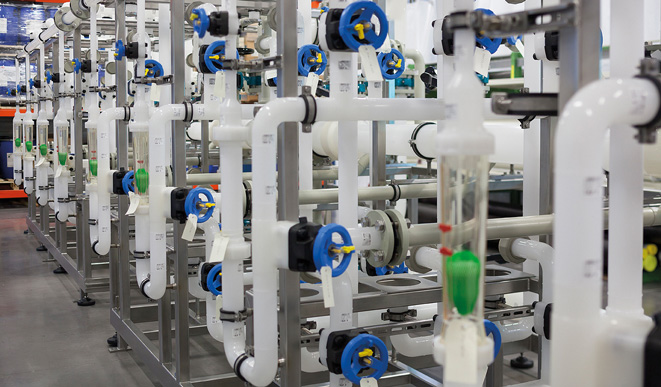
PVDF is melt-processable using standard thermoplastic techniques such as extrusion, injection molding, and welding. This makes it highly attractive for pipes, fittings, tanks, membranes, wire insulation, and structural components in chemical processing, water treatment, lithium-ion batteries, and semiconductor facilities.
The trade-off is reduced extreme performance. PVDF’s continuous service temperature is typically limited to around 140–150 °C, and while it has excellent resistance to many acids, salts, and halogens, it is less resistant than PTFE to certain strong bases and high-temperature solvents. In short, PVDF is chosen when mechanical strength and fabrication efficiency matter more than absolute chemical inertness.
Other Major Fluoropolymers and Where They Fit
Between PTFE and PVDF lies a spectrum of fluoropolymers engineered to balance performance and processability. Understanding these materials helps engineers avoid overdesign or underperformance.
| Fluoropolymer | Key Characteristics | Typical Advantages | Common Applications |
|---|---|---|---|
| FEP (Fluorinated Ethylene Propylene) | Fully fluorinated, melt-processable | PTFE-like chemical resistance with better processability | Wire insulation, tubing, linings |
| PFA (Perfluoroalkoxy) | Fully fluorinated, higher temp than FEP | Better mechanical strength and clarity than PTFE | Semiconductor piping, high-purity systems |
| ETFE (Ethylene Tetrafluoroethylene) | Partially fluorinated, very tough | High impact strength, radiation resistance | Cable insulation, architectural films |
| ECTFE (Ethylene Chlorotrifluoroethylene) | Partially fluorinated, low permeability | Excellent barrier properties | Chemical tanks, corrosion-resistant coatings |
| PVDF | Partially fluorinated, structural | Strong, weldable, cost-effective | Pipes, fittings, membranes, batteries |
These materials allow designers to fine-tune performance. For example, semiconductor fabs often choose PFA instead of PTFE because it combines ultra-high purity with weldability, while chemical plants may prefer ECTFE linings for permeation resistance rather than maximum temperature capability.

How to Choose the Right Fluoropolymer
Selecting the correct fluoropolymer should be a requirement-driven decision, not a brand-driven one. The following questions provide a practical framework:
• What is the maximum continuous and peak operating temperature?
• Which chemicals are present, and at what concentrations?
• Is mechanical load, pressure, or abrasion significant?
• Does the part need to be welded, injection-molded, or extruded?
• Are purity, permeability, or electrical properties critical?
• What is the acceptable cost versus lifetime trade-off?
In many real projects, PTFE is over-specified where PVDF, FEP, or ETFE would perform adequately at lower total cost. Conversely, PVDF is sometimes selected for applications that quietly exceed its temperature or chemical limits, leading to premature failure. Correct selection requires aligning material properties with the actual operating envelope, not the assumed one.
Conclusion: Different Tools for Different Extremes
PTFE, PVDF, and other fluoropolymers are not competitors so much as complementary tools. PTFE represents the extreme of chemical and thermal resistance, PVDF represents a balance of strength and manufacturability, and materials like FEP, PFA, ETFE, and ECTFE fill the gaps between them. The best choice is rarely “the most fluorinated,” but rather “the most appropriate for the job.”
Understanding these differences enables engineers, buyers, and plant operators to reduce overdesign, avoid hidden failure risks, and optimize both performance and cost across the full lifecycle of equipment and systems.
Discuss Fluoropolymer Selection with Sparrow-Chemical
If you are selecting fluoropolymer materials for chemical equipment, piping systems, linings, or high-performance applications and need help comparing PTFE, PVDF, or alternative fluoropolymers, Sparrow-Chemical can provide material selection guidance, specification support, and supply solutions matched to your operating conditions. Visit https://sparrow-chemical.com/ to start a technical discussion with our team.